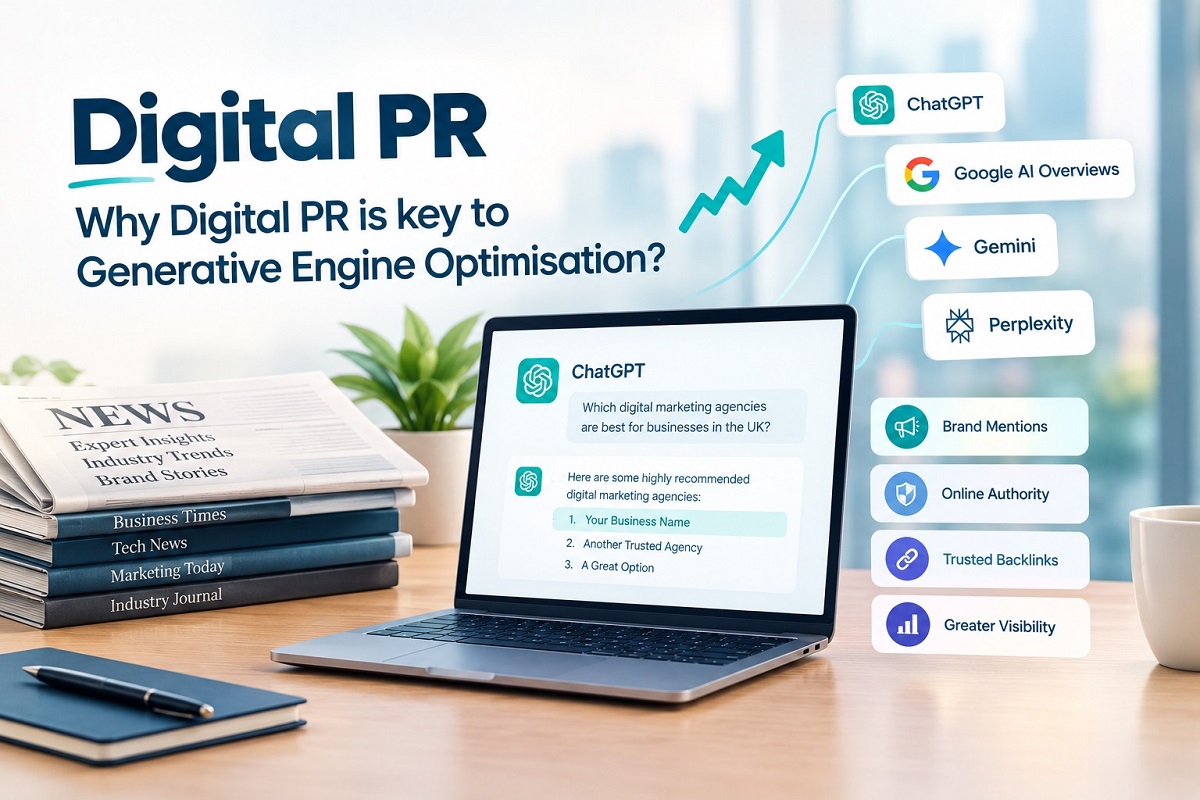
Search engines are changing how people discover businesses, compare services, and make purchasing decisions. Instead of clicking through multiple websites, users increasingly ask AI-powered platforms such as ChatGPT, Google AI Overviews, Gemini, and Perplexity for direct answers and recommendations. This shift creates new opportunities for brands to reach their audiences, but it also changes how businesses need to build online visibility.
Traditional SEO remains important, yet ranking highly in search results is no longer the only consideration. Businesses also need to establish credibility across the web so AI systems can discover, understand, and potentially reference their brands. This is where Digital PR becomes particularly valuable.
Generative Engine Optimisation (GEO) focuses on improving a brand’s visibility in AI-generated responses. Digital PR can support this process by earning relevant media coverage, building credible brand mentions, and strengthening a company’s reputation beyond its own website.
In this article, we explore why Digital PR is key to Generative Engine Optimisation and how businesses can use it to improve their visibility across emerging AI search platforms.
What Is Generative Engine Optimisation?
Generative Engine Optimisation is the practice of improving how a brand, business, or website is represented in responses produced by AI-powered search tools.
Unlike conventional search results, which often present a list of links, generative AI systems can summarise information from multiple sources to answer a user’s question. Depending on the platform and query, these answers may include brand names, recommendations, explanations, and links to supporting sources.
GEO SEO combines established search engine optimisation principles with strategies designed to improve visibility in these generative search experiences. Helpful content, accessible websites, clear business information, and credible external references can all contribute to a stronger online presence.
However, there is no guaranteed formula for appearing in AI-generated answers. Each platform uses different systems to retrieve, evaluate, and present information. Businesses should therefore focus on building genuine authority rather than trying to manipulate individual AI responses.
Why Is Digital PR Important for GEO?
Digital PR involves earning online publicity and media coverage through useful stories, expert commentary, original research, industry insights, and relationships with relevant publications.
Its value extends beyond traditional public relations. When credible websites discuss a company, explain its expertise, or reference its research, they create additional sources of information about that brand.
These external references can support AI search optimisation in several ways.
First, relevant coverage can introduce a brand to audiences who may never have visited its website. Second, independent sources can help potential customers verify its expertise. Third, useful coverage may create opportunities for search engines and AI systems to discover additional information about the business.
Digital PR does not directly control AI recommendations. Nevertheless, it can strengthen the broader online signals that contribute to discoverability, reputation, and brand recognition.
1. Build Brand Authority Through Trusted Media Coverage
Online brand authority develops when a business consistently demonstrates expertise and earns recognition from credible sources.
Digital PR provides a practical way to establish this recognition. Businesses can contribute expert opinions to industry publications, share original research, publish useful reports, and offer journalists insights into relevant industry developments.
For example, a digital marketing agency could publish research on changing search behaviour or provide expert commentary on the impact of AI on small businesses. If relevant publications reference this information, the agency gains exposure beyond its own website.
These mentions can strengthen online brand authority by associating the business with useful information and recognised industry discussions.
Quality matters more than quantity. A relevant mention in a respected industry publication may be more valuable than dozens of links from unrelated websites. Focus on earning coverage that reflects your expertise and helps readers understand why your business is worth considering.
2. Strengthen Brand Mentions Across the Web
Brand mentions are references to a business, product, or organisation on external websites. They may appear in news articles, industry reports, expert interviews, reviews, business directories, and other relevant online content.
These references are important because they help establish a broader picture of a brand’s identity and expertise.
For GEO, businesses should aim to earn accurate, relevant mentions that explain what they do and the audiences they serve. For example, an article mentioning an agency as a provider of technical SEO and AI search optimisation offers more context than a simple reference to its name.
Brand mentions do not guarantee that an AI platform will recommend a company. Their value comes from contributing to a consistent and credible digital presence that customers and search systems can encounter across multiple sources.
Businesses should prioritise genuine editorial coverage, accurate company information, and useful contributions rather than artificial mentions or spam-driven campaigns.
3. Earn Relevant Backlinks That Support Digital PR for SEO
Digital PR for SEO often involves earning editorial backlinks from trusted websites. These links can help search engines discover content, understand relationships between websites, and evaluate the relevance of linked resources.
A successful Digital PR strategy should prioritise links that arise naturally from valuable content and genuine editorial interest.
Consider creating original industry research, publishing a detailed expert guide, or producing a report containing useful statistics. These assets give journalists, bloggers, and industry professionals a reason to reference your website.
Backlinks remain an important consideration in traditional SEO, but they should not be treated as a direct guarantee of GEO performance. AI platforms do not all use the same retrieval or ranking mechanisms, and some may rely on sources that are not linked directly to your website.
The strongest approach is to create material worth citing and promote it to relevant publications, while maintaining sound technical SEO and useful on-site content.
4. Improve AI Search Visibility With Original Insights
AI search visibility depends partly on whether a brand can be discovered and whether its information is relevant to the question being asked. Original insights can help distinguish your content from the many generic articles already available online.
Publish research, case studies, expert commentary, customer insights, and practical explanations based on your experience. Where you use statistics or make factual claims, provide reliable sources and explain the context.
For example, a web design company could publish a study examining common website conversion problems among small businesses. A journalist writing about website performance might find the findings useful, while prospective customers may benefit from the recommendations.
This approach connects content marketing, Digital PR, and AI SEO. Instead of publishing content solely to target keywords, your business creates information that can be useful to readers, publishers, and potentially AI-powered search experiences.
5. Combine Digital PR With Answer Engine Optimisation
Answer Engine Optimisation (AEO) focuses on making content useful for systems that provide direct answers to users’ questions. It complements GEO by encouraging businesses to communicate information clearly and address specific search intent.
Digital PR and AEO work well together when your website provides clear answers and external coverage reinforces your expertise.
Start by identifying common customer questions. Create helpful service pages, FAQs, detailed guides, and articles that answer those questions directly. Then develop relevant PR campaigns that introduce your expertise or research to wider audiences.
For instance, if customers frequently ask how much SEO services cost, publish a transparent guide explaining pricing factors, service differences, and realistic expectations. You can then offer expert commentary on related topics to relevant publications.
This integrated approach helps make your expertise easier to understand while building awareness beyond your website.
6. Create a Consistent AI Search Marketing Strategy
AI search marketing should not be treated as a separate activity disconnected from SEO, content marketing, and public relations. These disciplines work best when they support the same business goals.
Begin by defining the topics your company wants to be known for. Develop useful website content around those topics, maintain accurate business profiles, and pursue media opportunities that reinforce your expertise.
Track indicators such as relevant media mentions, referral traffic, organic search performance, branded search activity, and qualified enquiries. Where possible, test relevant questions across AI search platforms to understand whether your brand appears and which sources are referenced.
Remember that AI responses can change depending on the platform, query, location, and available sources. A single test is not a reliable measure of long-term performance.
Review your results regularly and focus on activities that build lasting brand visibility, audience trust, and business growth.
How Businesses Can Get Started With Digital PR for GEO
You do not need a large public relations budget to begin improving your generative search presence. Start with a focused plan:
- Identify the subjects and services your business wants to be recognised for.
- Create useful content supported by genuine expertise, research, or experience.
- Identify relevant journalists, publications, and industry websites that cover those subjects.
- Offer original insights, expert commentary, or data that genuinely helps their audiences.
- Keep your website, business profiles, and service descriptions accurate and consistent.
- Measure media coverage, organic visibility, referral visits, and relevant AI search appearances over time.
Avoid mass-produced press releases, irrelevant link exchanges, fake reviews, and unsupported claims. Sustainable Digital PR depends on providing real value to the people who publish, read, and reference your content.
Make Digital PR Part of Your GEO Strategy
Generative Engine Optimisation is changing how businesses approach online discovery, but credibility and useful information remain essential. Digital PR helps businesses earn recognition beyond their own websites, develop stronger brand associations, and reach audiences through trusted publications.
By combining quality media coverage, relevant brand mentions, editorial backlinks, original research, and helpful website content, companies can build a stronger foundation for AI search visibility.
There is no guarantee that any campaign will secure a place in ChatGPT recommendations or other AI-generated answers. However, a consistent Digital PR strategy, supported by sound SEO and Answer Engine Optimisation, can strengthen your overall online presence and make your business easier for potential customers to discover.
Ready to improve your brand visibility in AI search? Start by identifying what your business can contribute that is genuinely useful, distinctive, and credible. Then build a Digital PR strategy around earning recognition for that expertise.
If you’re looking for expert SEO services to help manage content audits, updates, and optimization strategies, reach out to SEO Buckinghamshire—a leading digital agency in the UK with over 10 years of experience in SEO, web design, and digital marketing.