Search engines are becoming better at understanding content, while AI-powered search tools are changing how people discover information online. Today, publishing articles with relevant keywords is no longer enough to build a strong digital presence. Businesses need to demonstrate genuine experience, subject knowledge, reliability and trust to stand out in competitive search results.
This is where E-E-A-T and AI search become important. By creating accurate, useful and experience-driven content, businesses can strengthen their online reputation, improve user confidence and support long-term organic search visibility.
For businesses investing in digital marketing, understanding how to build content credibility is essential. A well-planned content strategy helps search engines understand a website’s purpose while giving readers a genuine reason to trust the information it provides.
What Is E-E-A-T in SEO?
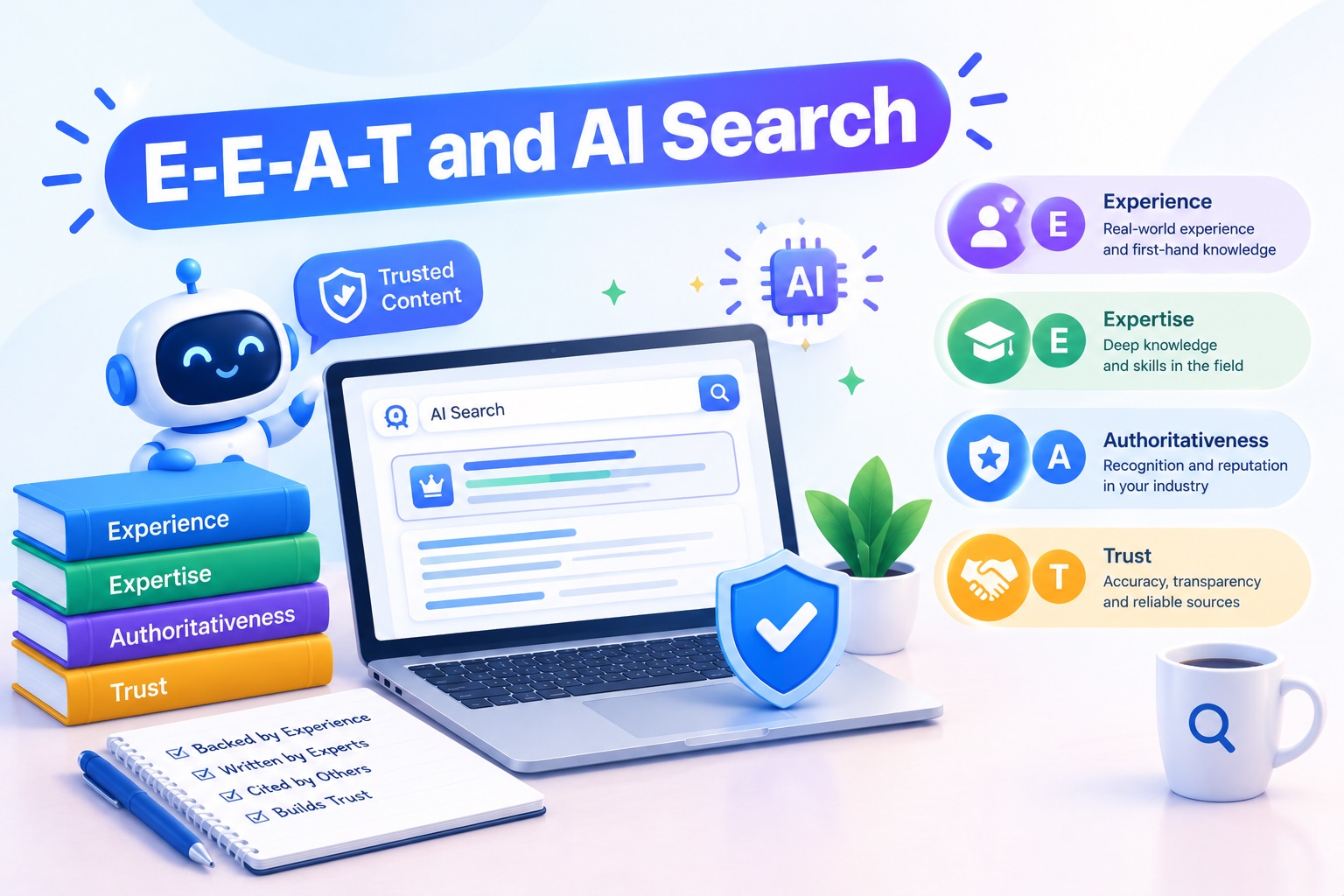
E-E-A-T stands for Experience, Expertise, Authoritativeness and Trustworthiness. Google uses these concepts within its Search Quality Rater Guidelines to help human evaluators assess the quality of search results. E-E-A-T is not a single direct ranking factor, but its principles align with creating helpful, reliable and people-first content.
Each element contributes to content credibility in a different way.
Experience means demonstrating first-hand knowledge of a subject. For example, a digital marketing agency can explain what it learned from carrying out a website SEO audit rather than simply repeating general advice.
Expertise refers to having relevant knowledge and skills. Detailed explanations, practical recommendations and accurate information help demonstrate content expertise.
Authoritativeness relates to the recognition a website, author or organisation earns within its field. Original research, relevant references and a consistent record of useful publications can help establish content authority.
Trustworthiness involves providing honest, accurate and transparent information. Clear authorship, reliable sources, secure website functionality and realistic claims all contribute to content trustworthiness.
Together, these principles provide a practical framework for creating SEO content that serves readers rather than simply targeting search engine algorithms.
Why E-E-A-T Matters for AI Search?
AI search tools can generate answers by drawing on information from multiple sources. Instead of relying exclusively on a list of traditional search results, users may receive summaries, recommendations and direct answers to their questions.
This shift makes content quality and credibility increasingly important. Businesses need to publish information that clearly explains a topic, answers relevant questions and provides enough context for readers to evaluate its usefulness.
Effective AI search optimisation begins with the same foundations as good search engine optimisation: useful information, accessible pages, accurate facts and a clear understanding of the audience.
Although no website can guarantee inclusion in AI-generated answers, publishing reliable content and maintaining a technically accessible website can support discoverability across search experiences.
For example, a UK business offering SEO services could publish a detailed guide explaining local SEO, common website problems and practical ways to improve search performance. Including relevant examples, transparent recommendations and evidence-based explanations gives readers more value than a generic article filled with repeated keywords.
The objective is not to write exclusively for AI systems. It is to create content that genuinely helps people and communicates its value clearly.
How to Build Content Credibility for Google and AI Search?
1. Demonstrate First-Hand Experience
One of the most effective ways to improve content credibility is to include insights that readers cannot easily find in every competing article.
Rather than repeating familiar advice, explain practical challenges, lessons learned and methods that have worked in relevant situations. Where appropriate, include original screenshots, case studies, examples, observations or documented results.
For instance, an article about improving website speed could explain how image compression, caching and code optimisation affect performance. If real project data is available, show the results accurately and explain the conditions under which they were achieved.
Avoid inventing case studies, customer experiences or performance statistics. Authentic information makes content more useful and supports long-term digital credibility.
2. Showcase Expertise and Author Authority
Readers should be able to understand who created an article and why that person or organisation is qualified to discuss the subject.
Include clear author biographies, relevant professional experience and links to other useful resources where appropriate. For specialist topics, involve qualified professionals or subject matter experts in writing or reviewing content.
Author authority develops through consistent, high-quality contributions rather than unsupported claims about being an industry leader.
Businesses should also maintain accurate About, Services and Contact pages. These pages help visitors understand the organisation, its expertise and how to reach it.
For SEO agencies, publishing useful guidance on technical SEO, content strategy, local search and AI SEO can help demonstrate knowledge across relevant areas without relying on exaggerated marketing promises.
3. Prioritise Helpful Content Over Keyword Density
Keywords remain useful because they help communicate a page’s subject and match the language people use when searching. However, excessive repetition can make articles difficult to read and reduce their usefulness.
Strong SEO content answers the reader’s main question early, explains important concepts clearly and provides practical next steps. Related keywords should appear naturally in headings, paragraphs and examples where they genuinely fit.
For an article about E-E-A-T SEO, relevant terms might include content trustworthiness, Google E-E-A-T, website authority, content quality and AI search optimisation. Each term should contribute meaningfully to the discussion.
Before publishing, ask whether the article provides original value, covers the topic adequately and resolves the reader’s likely concerns. Helpful content should leave readers better informed, not force them to search elsewhere for basic answers.
4. Support Claims With Reliable Evidence
Trust signals become particularly important when content includes statistics, industry trends, technical recommendations or factual claims.
Use reputable sources, link to original research when possible and distinguish verified information from opinions or predictions. Check dates and update references when information changes.
For example, an article discussing Google search guidance should refer to Google’s official documentation rather than relying entirely on second-hand interpretations.
Avoid unsupported guarantees such as promising first-page rankings or claiming that a particular content technique guarantees AI citations. Search performance depends on many factors, and responsible advice should acknowledge that uncertainty.
Accurate information and transparent explanations help readers make informed decisions and strengthen the perceived reliability of your website.
5. Strengthen Website Authority Through Consistent Publishing
Website authority is built over time through relevant, useful content and a credible online presence. Publishing many unrelated articles simply to increase website size is unlikely to create the same value as developing a focused resource library.
Build topic clusters around the services and questions most relevant to your audience. For example, a digital marketing website might connect articles about E-E-A-T, technical SEO, local SEO, topical authority and Generative Engine Optimisation.
Use internal links to connect related pages and help readers explore subjects in greater depth. Ensure that each page serves a distinct purpose instead of creating multiple articles that compete for the same search intent.
Relevant editorial mentions, genuine industry references and useful original resources can also contribute to reputation. Focus on earning recognition through value rather than pursuing links purely for quantity.
6. Optimise Content for Generative Engine Optimisation
Generative Engine Optimisation (GEO) focuses on improving the likelihood that useful content will be discovered, understood and potentially referenced in generative AI search experiences.
A practical GEO strategy starts with clear structure. Use descriptive headings, answer specific questions directly and explain technical concepts in straightforward language. Where relevant, provide definitions, comparisons, examples and supporting evidence.
Keep important information in accessible HTML text rather than relying exclusively on images or content that search systems may struggle to access. Use appropriate structured data to describe supported page elements, authors or organisations, ensuring that the markup accurately reflects visible content.
AI search optimisation should also include sound technical foundations: crawlable pages, sensible internal linking, mobile usability and accurate indexing signals.
Remember that structured data and formatting do not guarantee AI citations. They are supporting elements within a broader strategy focused on accessibility, relevance and content quality.
Common E-E-A-T Mistakes to Avoid
- Businesses can undermine credibility when they prioritise search performance over reader needs. Common mistakes include publishing generic AI-generated articles without meaningful review, using fabricated statistics, hiding authorship and making unsupported claims about professional experience.
- Another problem is allowing outdated information to remain published. Review important pages regularly, correct factual errors and update content when industry guidance changes.
- Avoid adding author biographies, testimonials or credentials that cannot be verified. Likewise, do not assume that adding every available schema type will automatically improve rankings.
- A more sustainable approach combines editorial oversight, accurate information, relevant expertise and a consistent commitment to helping readers. AI tools can assist with research and drafting, but human judgement remains important for checking facts, adding context and ensuring that the final content meets real audience needs.
How to Measure Content Credibility and SEO Performance
Content credibility cannot be measured through a single score. Instead, evaluate several indicators to understand whether your content is becoming more useful and discoverable.
Monitor organic impressions, clicks, relevant keyword rankings and engagement using tools such as Google Search Console and Google Analytics. Review which pages attract qualified visitors and whether those visitors take meaningful actions, such as submitting an enquiry or requesting a consultation.
You can also assess editorial quality through regular content audits. Check whether articles have clear authorship, accurate references, useful examples, appropriate internal links and up-to-date information.
For AI search, track available referral traffic and brand mentions where reliable data is accessible. Attribution may be incomplete, so avoid treating any single metric as a complete picture of AI visibility.
Use these insights to improve content that already serves an audience rather than publishing new pages solely to chase search trends.
Build a More Credible Online Presence With SEO Buckinghamshire
Building content credibility requires more than adding keywords to a webpage. It involves demonstrating experience, communicating expertise, supporting claims with evidence and creating useful resources that deserve readers’ trust.
As traditional search evolves alongside AI-powered discovery, businesses that invest in content quality, technical accessibility and a consistent publishing strategy can establish a stronger foundation for long-term visibility.
SEO Buckinghamshire is one of the leading SEO agencies in the UK, helping businesses strengthen their online presence through strategic search engine optimisation and digital marketing services. If you want to improve your website’s content quality, build topical authority and develop a sustainable SEO strategy, our team can help you identify opportunities tailored to your business goals.
Contact SEO Buckinghamshire to get started and take the next step towards building a more credible, visible and competitive online presence.
If you’re looking for expert SEO services to help manage content audits, updates, and optimization strategies, reach out to SEO Buckinghamshire—a leading digital agency in the UK with over 10 years of experience in SEO, web design, and digital marketing.