Search is evolving as users increasingly turn to AI-powered platforms such as ChatGPT, Perplexity, Gemini and Google AI Overviews to find information, compare services and discover businesses. For companies, appearing in traditional search results is no longer the only way to build online visibility. Brands also need to understand whether AI-generated answers mention their business, cite their content and recommend their services.
This is where Generative Engine Optimization (GEO) becomes important. But how can businesses determine whether their GEO strategy is working? By tracking the right GEO metrics, monitoring AI search visibility and connecting performance data to meaningful business outcomes.
In this guide, we explain how to measure GEO success, which key performance indicators to monitor and which tools can help businesses improve their visibility across AI search platforms.
What Is GEO Measurement and Why Does It Matter?
GEO measurement is the process of evaluating how frequently and accurately a brand appears in AI-generated answers. Unlike traditional SEO, which often focuses on keyword rankings, impressions and clicks, GEO also considers brand mentions, citations, recommendations and visibility across conversational search experiences.
Measuring GEO performance helps businesses understand whether their content is becoming a useful source for AI-generated responses. It also reveals which topics competitors dominate, where content improvements are needed and whether AI discovery contributes to website visits and enquiries.
Without a measurement strategy, businesses may invest in AI search optimization without knowing which activities produce meaningful results. A structured approach makes it easier to identify progress, refine content and demonstrate the value of GEO over time.
Key Metrics to Measure GEO Success
Tracking several complementary indicators provides a more reliable picture of performance than relying on a single visibility score.
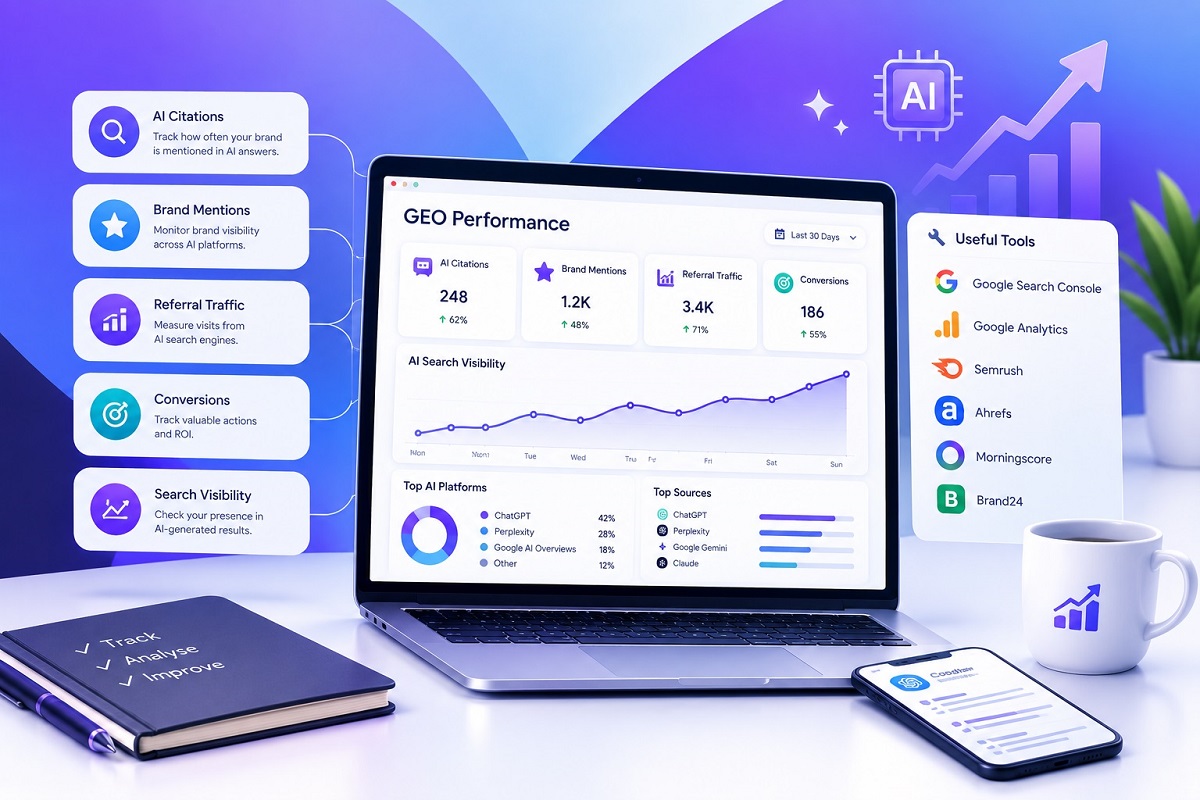
1. AI Brand Mentions
Brand mentions measure how often your company appears in AI-generated answers, even when the answer does not include a clickable link to your website.
For example, if a user asks ChatGPT to recommend a digital marketing agency in the UK, your brand appearing in the response indicates that it has gained visibility for a relevant query.
To measure this metric, create a list of questions potential customers might ask and test them across relevant AI platforms. Record whether your brand appears, how it is described and whether the information is accurate.
This process helps you understand how to measure brand visibility in AI search results and identify opportunities to improve brand recognition.
2. AI Citation Rate
AI citation rate measures how frequently AI-generated answers reference your website or content as a source. This is one of the most useful GEO metrics because it indicates whether your pages are being selected to support AI-generated responses.
A simple formula is:
AI Citation Rate = (Answers citing your website ÷ Total valid answers tested) × 100
For example, if your website is cited in 20 out of 100 tested answers, your citation rate is 20% for that specific sample.
To understand how to measure AI search citation rate accurately, keep your test questions consistent and record results separately for each platform. A higher citation rate over time can indicate progress, although results vary by topic, engine and query.
3. AI Search Visibility and Share of Voice
AI search visibility measures how frequently your brand appears across a defined set of relevant questions. Share of voice compares your visibility with that of competing businesses.
Suppose your agency appears in 25 relevant AI answers, while three competitors appear in 30, 20 and 15 answers respectively. Comparing these results helps you understand your relative visibility and discover topics where competitors are more prominent.
Monitor performance across different query types, including informational searches, service comparisons and commercial recommendations.
These insights help identify content gaps and establish more useful targets for improving AI search visibility.
4. Citation Quality and Brand Accuracy
Not all mentions deliver equal value. Your brand may appear in an AI answer, but the response might describe your services incorrectly or cite an outdated page.
Review the context of each mention. Check whether the AI platform presents your business accurately, whether your website is cited directly and whether the cited content supports the answer.
Also record whether your brand is recommended prominently or mentioned only briefly. These qualitative GEO KPIs help businesses understand how AI platforms represent their expertise and identify information that needs updating.
5. AI Referral Traffic
Visibility is valuable, but businesses also need to know whether AI-generated answers encourage users to visit their websites.
AI referral traffic measures visits arriving from identifiable AI platforms. Google Analytics 4 (GA4) can help you investigate referral sources, landing pages, engagement and conversions.
Review referral traffic from platforms such as ChatGPT and Perplexity where referral information is available. Some AI search experiences may be grouped under other channels, so the data will not capture every interaction.
Compare traffic trends with the pages being cited and the topics covered in your GEO campaign. This can help you identify content that attracts visitors after AI-assisted discovery.
6. Leads, Conversions and GEO ROI
The ultimate objective of GEO is not simply to appear in AI answers. It is to support business growth.
Track enquiry submissions, calls, bookings, qualified leads and sales wherever reliable attribution is available. Use GA4 alongside your customer relationship management (CRM) system to connect measurable visits with business outcomes.
To estimate the return on investment, use this formula:
GEO ROI = [(Attributed revenue − GEO investment) ÷ GEO investment] × 100
For example, if a campaign generates £6,000 in attributable revenue against £2,000 in campaign costs, the calculated ROI is 200%.
Treat this as an estimate when attribution is incomplete. AI visibility may influence customers who later return through direct visits or branded searches, meaning not every assisted conversion will be directly measurable.
Best Tools to Measure GEO Performance
Choosing the right tools depends on your budget, business goals and reporting requirements. Most businesses benefit from combining traditional analytics with dedicated AI visibility monitoring.
Google Search Console
Google Search Console helps monitor organic search impressions, clicks, search queries and page performance. These insights can reveal changes in branded searches and the performance of content supporting your GEO strategy.
Where dedicated reporting is available, use it to investigate relevant AI search appearances. However, do not assume every AI-generated impression or citation is separately reported.
Google Analytics 4
GA4 helps measure website sessions, referral sources, engagement and conversions. Create suitable reports or segments to investigate identifiable visits from AI platforms.
This is particularly useful for understanding whether AI-referred visitors explore service pages, submit enquiry forms or complete other important actions.
Dedicated AI Visibility Tools
Specialist AI visibility platforms can help automate prompt tracking, brand mention monitoring, citation analysis and competitor comparisons.
Tools worth evaluating include Profound, Otterly.AI, Peec AI and Semrush’s AI visibility capabilities. Features, platform coverage and pricing vary, so check current availability and confirm that a tool tracks the AI platforms relevant to your audience.
These are among the options to consider when evaluating the best GEO analytics tools for businesses.
Manual Prompt Testing and Reporting
Smaller businesses can begin without investing in specialist software. Create a spreadsheet containing target questions, AI platforms, brand mentions, cited URLs, competitor appearances and observations.
Run the same questions regularly, save the responses and compare the results. Manual testing requires more effort, but it provides a practical baseline before investing in paid AI visibility tools.
How to Track Generative Engine Optimization Performance
A consistent measurement process makes GEO reporting more useful and actionable.
- Step 1: Establish a baseline. Record your current brand mentions, citation rate, competitor visibility, referral traffic and conversions wherever data is available.
- Step 2: Choose relevant questions. Build a list of realistic customer queries covering your services, industry topics and purchasing decisions.
- Step 3: Monitor multiple platforms. Test the same questions across relevant AI search experiences and record the results separately.
- Step 4: Improve your content. Strengthen factual accuracy, demonstrate expertise, answer questions directly, maintain clear website structure and support important claims with credible sources.
- Step 5: Review trends regularly. Compare results over several reporting periods instead of making decisions based on a single AI response. Use the findings to update your content strategy and prioritize topics with the greatest business potential.
How Webvizion Can Help Improve Your GEO Strategy?
Successful GEO combines useful content, strong technical SEO, credible sources and consistent performance measurement. Businesses need to understand not only whether AI platforms mention their brand, but also whether that visibility supports relevant traffic and commercial goals.
As a UK SEO company, Webvizion helps businesses strengthen their digital presence through SEO strategy, content optimization and website improvements. A structured approach to GEO can help identify visibility gaps, improve the usefulness of existing content and establish a clearer process for measuring results.
The right strategy depends on your industry, target audience and current website performance. Start with measurable objectives, select relevant AI visibility tools and refine your approach as reliable data becomes available.
Turn GEO Insights into Measurable Growth
Understanding how to measure GEO success gives your business a clearer view of its visibility across AI-powered search experiences. By monitoring brand mentions, citation rates, competitor presence, referral traffic and conversions, you can move beyond assumptions and make better-informed optimization decisions.
No single metric or tool guarantees stronger rankings or AI recommendations. However, consistent tracking, helpful content and ongoing improvements can put your business in a stronger position to earn visibility as search continues to evolve.
If you’re looking for expert SEO services to help manage content audits, updates, and optimization strategies, reach out to SEO Buckinghamshire—a leading digital agency in the UK with over 10 years of experience in SEO, web design, and digital marketing.