Search behaviour is changing rapidly. People are no longer relying only on traditional search engine results to find information, compare services and make purchasing decisions. They are increasingly using AI-powered search experiences, including Google AI Overviews, ChatGPT and other AI assistants, to discover businesses and find answers to their questions.
For businesses, this creates a new opportunity to reach potential customers. However, having a website that performs well in traditional search results does not automatically guarantee visibility in AI-generated answers. Your website also needs clear content, accessible pages, reliable information and a strong technical foundation.
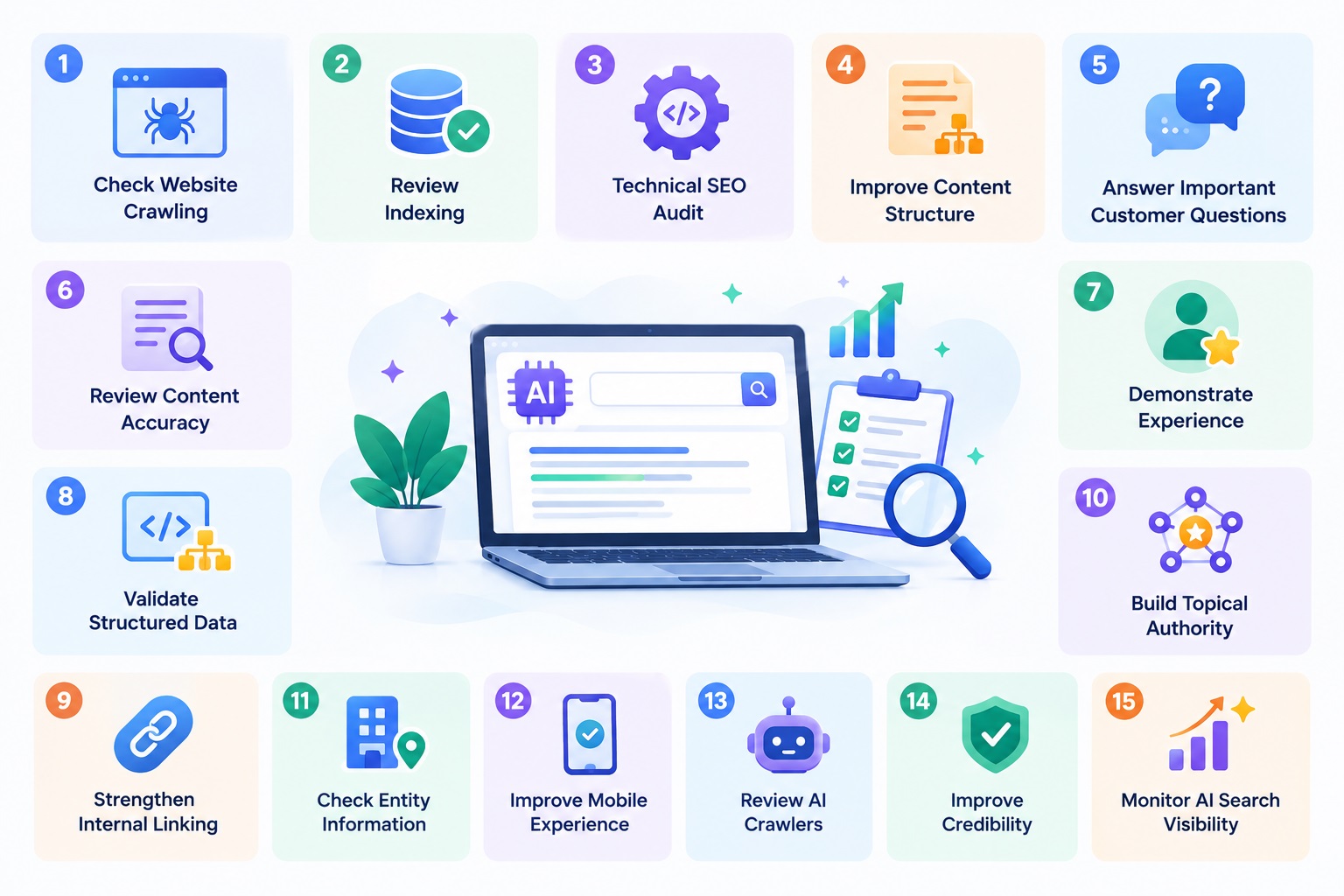
An AI search SEO audit checklist helps you identify the improvements that may support your website’s visibility across traditional search engines and AI-powered discovery platforms. Whether you manage a small business website or a large corporate website, these 15 checks can help you understand where your SEO strategy needs attention.
What Is an AI Search SEO Audit?
An AI SEO audit evaluates how effectively your website supports discovery through search engines and AI-powered search experiences. It examines technical SEO, content quality, structured data, website authority and the clarity of information available to users and automated systems.
Traditional SEO remains important, while Generative Engine Optimisation (GEO) and Answer Engine Optimisation (AEO) focus on making information useful and accessible for AI-generated answers. Neither approach guarantees citations, but both can complement a well-planned SEO strategy.
Use the following website audit checklist for AI search visibility to identify potential weaknesses and prioritise improvements.
1. Check Website Crawling and Accessibility
Search engines need to discover your pages before they can evaluate and potentially show them in search results. Start your AI search SEO audit by checking your robots.txt file, XML sitemap and important page URLs.
Make sure valuable content is not accidentally blocked by crawling rules, login requirements or incorrect server settings. Review access for relevant search and AI crawlers, following each platform’s published documentation.
2. Review Indexing and Canonical Tags
A technically accessible page is not necessarily indexed. Use Google Search Console to check whether important URLs are indexed and investigate exclusions, redirects and crawl errors.
Review canonical tags to ensure they identify the preferred version of each page. Duplicate or conflicting URLs can complicate search engine understanding and waste crawling resources.
These checks form an essential part of any AI search SEO audit checklist for websites because search visibility depends on a reliable technical foundation.
3. Conduct a Technical SEO Audit
A technical SEO audit should examine broken links, redirect chains, HTTPS implementation, mobile usability and Core Web Vitals. Slow or unstable pages can create a poor user experience and make important content harder to access.
Use Google PageSpeed Insights and Search Console to identify performance issues. Fix critical errors first, particularly those affecting important service pages, landing pages and educational content.
A technical SEO checklist for AI search optimisation should support both efficient crawling and a positive experience for visitors.
4. Improve Content Structure and Readability
AI search systems need to interpret the information available on your website. Clear headings, descriptive paragraphs and logical page structures help readers understand your content and may help automated systems identify relevant information.
Use one clear main heading, organise supporting sections with descriptive subheadings, and avoid unnecessary jargon. Explain specialist terms when they first appear.
If you are wondering how to make website content visible in AI search, start by making every important page easy to understand, navigate and interpret.
5. Answer Important Customer Questions Directly
Useful content should address the questions your target audience actually asks. Identify common concerns about your services, pricing, processes, benefits and potential limitations.
Provide direct answers before expanding with examples and supporting explanations. For instance, a local SEO agency could explain what a local SEO audit includes, how long improvements may take and which performance metrics matter.
This approach supports Answer Engine Optimisation by making useful information easier to find and understand without sacrificing depth or readability.
6. Review Content Accuracy and Freshness
Outdated statistics, incorrect service details and old recommendations can weaken user trust. Review important pages regularly to confirm that their information remains accurate.
Update content when meaningful changes occur, rather than changing publication dates simply to make an article appear fresh. Add current examples, verify external references and remove claims that cannot be supported.
Reliable information is particularly important when learning how to optimise website content for AI Overviews and other AI-assisted search experiences.
7. Demonstrate Experience, Expertise and Trust
Search visibility depends on more than technical optimisation. Your website should give visitors good reasons to trust your business and the information you publish.
Include accurate company details, relevant experience, clear service descriptions and accessible contact information. Where appropriate, provide author information, case studies, genuine testimonials and links to credible sources.
Avoid fabricated reviews, exaggerated promises and unsupported claims. A trustworthy website helps potential customers make informed decisions and strengthens the overall quality of your online presence.
8. Validate Structured Data and Schema Markup
Structured data helps search engines interpret specific information about your business, services, articles and other entities. Depending on the page, relevant schema types may include Organisation, LocalBusiness, Article and BreadcrumbList.
Validate your implementation using Google’s Rich Results Test and Schema Markup Validator. Ensure the markup accurately reflects visible page content and does not contain misleading information.
Schema is not a guaranteed shortcut to AI citations, but accurate structured data can support machine-readable understanding and remains a valuable part of a comprehensive website SEO audit.
9. Strengthen Internal Linking
Internal links connect related pages and help visitors discover additional useful information. They can also help search engines understand the relationships between topics across your website.
Link relevant blog articles to service pages, connect related guides and use descriptive anchor text. Avoid excessive links or generic wording that provides little context.
For example, an article about technical SEO can link to a dedicated SEO audit service page. This creates a clearer journey for users while helping search engines discover important content.
10. Build Topical Authority with Useful Content
Publishing multiple pages on the same subject is not enough to establish authority. Your content should cover the topic comprehensively and provide genuinely useful information that competitors’ pages may overlook.
Create supporting articles around customer questions, practical problems, industry developments and relevant case studies. Connect these resources through a logical internal linking structure.
A GEO audit checklist for websites should assess whether your content demonstrates meaningful subject knowledge rather than repeating similar keywords across multiple pages.
11. Check Entity Information and Brand Consistency
Your business name, address, contact details, services and other key information should be consistent wherever they appear online.
Review your website, business directories and relevant professional profiles for outdated or conflicting details. Explain what your business does, whom it serves and which locations it covers.
Consistent, accurate information can help search engines and users understand your business. However, consistency alone does not guarantee that an AI platform will recognise or recommend your brand.
12. Improve Mobile Experience and Page Performance
Many potential customers discover businesses through mobile devices. Ensure your website works well on smaller screens, with readable text, accessible menus, clear calls to action and forms that are easy to complete.
Review Core Web Vitals and test important pages on different devices. Compress oversized images, remove unnecessary scripts and improve hosting performance where needed.
These are important website SEO factors that affect AI search visibility indirectly by supporting accessibility, usability and overall search performance.
13. Review Access for Relevant AI Crawlers
Different AI platforms use different crawlers and access rules. Check the official documentation for the platforms relevant to your audience and determine whether your robots.txt configuration or server security settings restrict access unintentionally.
Some crawlers serve search discovery, while others support model training or different product functions. Decide which access permissions align with your business requirements and privacy policies.
Do not assume that allowing every crawler will improve rankings. Focus on the systems and purposes relevant to your website.
14. Improve Credibility with Evidence and Sources
Support factual claims with reliable evidence. When discussing industry statistics, technical recommendations or market developments, reference authoritative sources and explain what the information means for readers.
Where suitable, include original research, first-hand experience, examples and practical insights. Avoid rewriting existing articles without adding meaningful value.
These SEO audit tips for ChatGPT and Google AI search can help improve the usefulness and credibility of your content, although inclusion in AI-generated answers remains outside your direct control.
15. Monitor AI Search Visibility and Performance
Your final AI SEO audit step is to establish a baseline and monitor progress. Track organic impressions, clicks, indexed pages, relevant keyword rankings and conversions using Google Search Console and analytics tools.
You can also periodically test relevant questions in AI search platforms to see whether your business or content appears in responses. Record the questions tested, dates, citations and referral traffic where measurable.
This helps you assess how to improve website visibility in AI search results while distinguishing measurable performance from occasional or unverified observations.
How to Check If Your Website Is Ready for AI Search?
Start with crawling, indexing and technical errors, then review content quality, structured data, internal links and brand credibility. Prioritise fixes that affect important pages and real customer journeys instead of making every change at once.
This practical AI SEO audit checklist for better visibility can help you establish a repeatable review process. Revisit the checklist after major website updates and whenever your business goals or search performance change.
Remember that AI search optimisation is not a replacement for traditional SEO. A balanced approach to technical health, useful content and trustworthy business information gives your website a stronger foundation for evolving search experiences.
Work with SEO Buckinghamshire to Improve Your Search Visibility
If your website is struggling to attract organic traffic or you want to prepare your business for changing search behaviour, professional SEO support can help you identify the right priorities.
SEO Buckinghamshire is one of the best and leading SEO agencies in the UK, helping businesses strengthen their online presence through strategic SEO, technical improvements, content optimisation and digital marketing solutions.
Our approach focuses on understanding your website, identifying opportunities and developing practical recommendations aligned with your business goals. From a comprehensive website SEO audit to ongoing optimisation, we can help you build a stronger foundation for sustainable online growth.
If you’re looking for expert SEO services to help manage content audits, updates, and optimization strategies, reach out to SEO Buckinghamshire—a leading digital agency in the UK with over 10 years of experience in SEO, web design, and digital marketing.