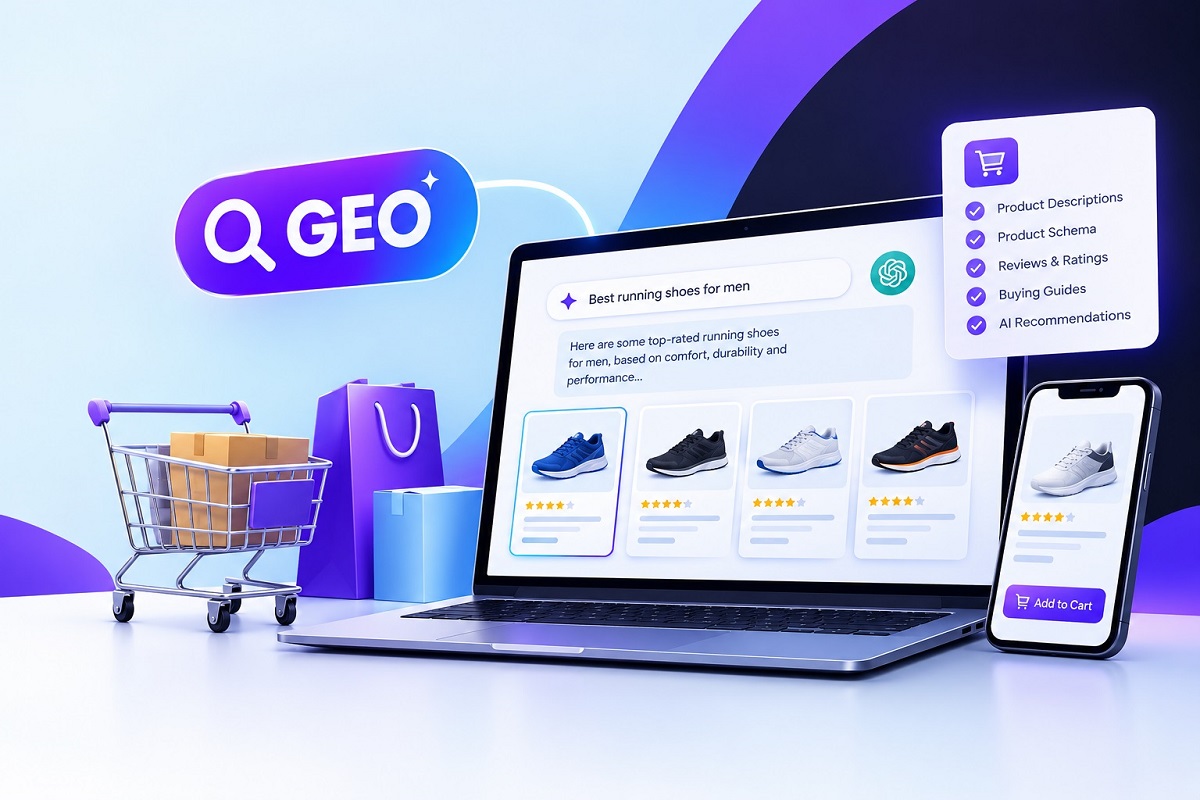
Online shopping is changing as customers increasingly use AI-powered tools to research products, compare options, and find recommendations before making a purchase. Instead of relying only on traditional search engines, shoppers may ask platforms such as ChatGPT questions like “Which running shoes are best for beginners?” or “Recommend a skincare product for sensitive skin.”
These changes create new opportunities for ecommerce businesses. If your products are accurately represented in online content, supported by trustworthy information, and easy for AI systems to understand, they may have a better chance of appearing in relevant AI-generated recommendations.
This is where GEO for ecommerce becomes important. Generative Engine Optimization (GEO) focuses on improving how content, products, and brands are understood and referenced by AI-powered search and answer systems.
For online retailers, the goal is to make product information useful, accessible, reliable, and relevant wherever customers search.
What Is GEO for Ecommerce?
GEO for ecommerce is the process of optimizing an online store and its product information so that AI-powered search experiences can understand, evaluate, and potentially recommend its products.
Traditional ecommerce SEO focuses on improving visibility in search engine results through relevant keywords, technical performance, quality content, and backlinks. Ecommerce GEO builds on these foundations by considering how AI systems interpret questions, identify relevant sources, and generate answers.
For example, a customer might search for “affordable waterproof hiking boots for beginners.” An AI-powered search experience could consider product specifications, customer reviews, published buying guides, and other accessible information when generating recommendations.
An ecommerce website that clearly explains its products, intended uses, features, limitations, and benefits gives search systems more useful information to interpret.
GEO does not guarantee that a product will be recommended. AI platforms use different systems and sources, and their results can change. However, improving product information and website accessibility can help establish a stronger foundation for AI search visibility.
Why Ecommerce GEO Matters for Online Stores?
Product discovery is no longer limited to browsing category pages or clicking traditional search results. AI shopping experiences can help customers narrow their choices, compare products, and find solutions to specific problems.
This makes AI product recommendations an increasingly relevant consideration for online retailers.
When someone asks an AI assistant to recommend a laptop for university, for example, the answer may depend on factors such as budget, battery life, portability, performance, and available product information.
If your store provides detailed and accurate information about these characteristics, it becomes easier for search systems to understand whether your product matches a particular need.
Ecommerce GEO can support several business objectives:
- Improve opportunities for product discovery through AI-powered search.
- Help customers understand product features and benefits.
- Build trust through consistent product information and credible supporting content.
- Reach shoppers researching specific needs, budgets, and product comparisons.
- Complement existing ecommerce SEO activities.
AI visibility should be treated as an additional discovery channel rather than a replacement for conventional search optimization.
How to Get Ecommerce Products Recommended by AI?
There is no single technique that guarantees AI recommendations. A practical approach combines strong product pages, structured information, helpful content, and a trustworthy online presence.
1. Create Detailed and Helpful Product Pages
Product pages are among the most important assets for ecommerce GEO. A page that only lists a product name, price, and a few generic benefits may not provide enough information to answer detailed customer questions.
Explain what the product does, who it is designed for, and which problems it solves. Include important specifications, materials, dimensions, compatibility, care instructions, and relevant limitations.
For example, instead of describing a backpack as “high quality and durable,” explain its capacity, material, laptop compartment size, water-resistance characteristics, and recommended use.
This approach helps customers make informed decisions while giving search systems clearer product context.
If you want to understand how to optimize product pages for AI recommendations, begin by answering the questions customers commonly ask before purchasing.
2. Use Structured Data to Explain Your Products
Structured data helps search engines interpret important details about products. Implementing relevant Product and Offer schema can communicate information such as product names, descriptions, prices, availability, brand details, and identifiers where applicable.
Review and rating markup may also be appropriate when it meets the relevant platform’s requirements.
Use JSON-LD where practical, ensure the markup matches the visible page content, and validate it using Google’s Rich Results Test and Schema Markup Validator.
Structured data does not guarantee AI citations or product recommendations. However, accurate markup can improve machine readability and support eligible search experiences.
Keep product prices and availability updated, particularly when inventory changes frequently.
3. Publish Content That Answers Shopping Questions
AI search often involves natural-language questions rather than short product keywords alone. Your content should address the questions people ask while researching a purchase.
Create buying guides, product comparisons, frequently asked questions, and practical tutorials related to your product categories.
For example, a store selling coffee machines could publish articles covering:
- Which coffee machine is suitable for a small kitchen?
- What is the difference between automatic and manual coffee machines?
- Which features matter when buying a coffee machine for home use?
- How should a coffee machine be cleaned and maintained?
Useful content supports AI product discovery by explaining product categories and helping customers understand their options.
Avoid creating large volumes of repetitive articles simply to target AI search. Original insights, accurate advice, and genuinely helpful comparisons provide more value.
4. Improve Product Visibility Across Trusted Sources
Your own website is not the only place where customers may discover your brand. Product information can also appear on retailer directories, relevant publications, comparison websites, manufacturer pages, and other legitimate online sources.
Maintain consistent brand names, product descriptions, specifications, and identifiers wherever your business controls the information.
Encourage genuine customer reviews and respond professionally to feedback. Reviews can reveal how products perform in real situations and help shoppers assess their suitability.
Relevant digital PR, expert mentions, and useful industry content may also strengthen your brand’s online presence. Never rely on fabricated reviews or misleading claims to influence AI recommendations.
5. Make Product Information Easy to Access
Technical accessibility remains important for AI search optimization. If essential product information is missing, blocked, outdated, or difficult to retrieve, search systems may have trouble using it.
Ensure important product pages can be crawled by the relevant search engines. Review robots.txt rules, canonical tags, XML sitemaps, redirects, and page status codes.
Keep key information in accessible page content rather than relying entirely on images or interface elements that may not be interpreted consistently.
Also check whether relevant AI search services publish crawler documentation and access requirements. Different platforms may have different policies, and access should be managed deliberately.
A technically sound website supports both traditional Ecommerce SEO and efforts to improve product visibility in AI-powered search.
GEO Strategies for Ecommerce Product Visibility
The best GEO strategies for ecommerce product visibility combine several complementary activities instead of depending on a single optimization trick.
Start with product data quality. Every important product should have an accurate title, a useful description, current pricing, availability information, and relevant attributes.
Next, organize your website logically. Use descriptive category pages, sensible internal links, and clear relationships between products, collections, and supporting guides.
Where appropriate, create comparison tables that explain meaningful differences between products. Include measurable details rather than unsupported claims such as “the best product on the market.”
Finally, strengthen your wider content strategy. Publish original buying advice, demonstrate relevant expertise, and update older content when specifications, prices, or customer needs change.
These are among the best GEO practices for ecommerce websites because they improve the underlying quality of the information available to both customers and search systems.
How to Get Products Recommended by ChatGPT?
Businesses often ask how to get products recommended by ChatGPT. The practical answer is to make product information accurate, accessible, relevant, and supported by credible sources.
Start by reviewing the pages that describe your most important products. Check whether the content clearly communicates the product’s purpose, specifications, benefits, limitations, and ideal customer.
Ensure your website is accessible to the relevant search and retrieval systems, subject to their individual policies. Maintain consistent information across your website and other reputable sources.
You can also test representative customer questions in available AI search tools. Ask questions about product categories, use cases, budgets, and comparisons to see whether your brand appears and whether the information presented about it is correct.
These tests are useful for identifying content gaps, but they are not definitive rankings. Responses can vary by prompt, location, platform, and time. No business can guarantee inclusion in every AI-generated answer.
How to Measure AI Search Optimization Results?
GEO should be measured alongside your existing SEO performance. Track whether your work improves the quality of product discovery and contributes to meaningful business outcomes.
Useful measurements include referral traffic from identifiable AI platforms, engagement on product pages, organic search impressions, product page conversions, and sales attributed to relevant channels.
You can also maintain a consistent set of product-related questions and periodically check how different AI tools describe your brand and products. Record incorrect details, missing product categories, and competitor mentions to identify opportunities for improvement.
Not every AI interaction produces a measurable website visit, so referral analytics alone may not capture the full impact of AI product discovery.
Use these observations to refine product descriptions, technical implementation, supporting content, and your wider marketing strategy.
How to Increase Ecommerce Visibility in AI-Powered Search?
Improving visibility requires ongoing work rather than a one-time optimization. Begin with a technical and content audit to identify weak product descriptions, missing structured data, outdated information, and important pages that are difficult to discover.
Prioritize your most valuable product categories first. Improve their pages, add useful supporting guides, verify structured data, and strengthen internal linking. Then monitor search performance, customer engagement, and available AI referral data.
Continue updating your content as products change and customer questions evolve.
Remember that GEO complements rather than replaces conventional SEO. Strong technical foundations, relevant content, trustworthy information, and a good user experience remain important across multiple discovery channels.
Improve Your Ecommerce Visibility with SEOBuckinghamshire
AI-powered search is creating new ways for customers to discover products, compare alternatives, and choose online retailers. Ecommerce businesses that invest in useful product information and a clear content strategy can prepare for these changing search experiences.
At SEOBuckinghamshire, we help businesses strengthen their digital presence through SEO, website optimization, technical improvements, and content strategies designed around their customers.
Whether you are improving an existing online store or developing a new ecommerce website, a structured approach to SEO and Generative Engine Optimization can help build a stronger foundation for long-term organic visibility.
Want to improve your website’s visibility in traditional and AI-powered search? Contact SEOBuckinghamshire to discuss an ecommerce SEO and GEO strategy tailored to your business.
If you’re looking for expert SEO services to help manage content audits, updates, and optimization strategies, reach out to SEO Buckinghamshire—a leading digital agency in the UK with over 10 years of experience in SEO, web design, and digital marketing.