In a competitive digital landscape, publishing blog posts regularly is not enough to achieve sustainable search visibility. Search engines need to understand what your website covers, how well your content answers users’ questions, and whether your pages provide useful information. This is where topical authority in SEO becomes important.
Topical authority refers to the depth, relevance, and consistency of the content a website publishes about a particular subject. Instead of covering dozens of unrelated topics, businesses can build a stronger online presence by addressing the important questions, challenges, and interests within their industry.
For businesses investing in search engine optimisation, developing topical authority can support better content discovery, stronger internal linking, and increased organic visibility. In this guide, we explain how to build topical authority in SEO and become a trusted source in your industry.
What Is Topical Authority in SEO?
Topical authority is the perceived expertise and relevance a website demonstrates by consistently publishing useful, accurate, and comprehensive information about a specific subject.
For example, a digital marketing agency that publishes detailed resources about technical SEO, local SEO, keyword research, content optimisation, and AI search is developing a connected body of knowledge around search marketing.
This approach helps visitors find answers to related questions without searching across multiple websites. It also helps search engines understand the relationship between different pages and the broader subject they address.
However, topical authority is not a guaranteed ranking factor that can be increased simply by publishing more articles. Strong search performance depends on several factors, including content quality, relevance, technical accessibility, competition, and the usefulness of each page.
A successful SEO topical authority strategy therefore focuses on serving users comprehensively rather than producing large volumes of repetitive content.
Why Topical Authority Matters for Search Engine Optimisation?
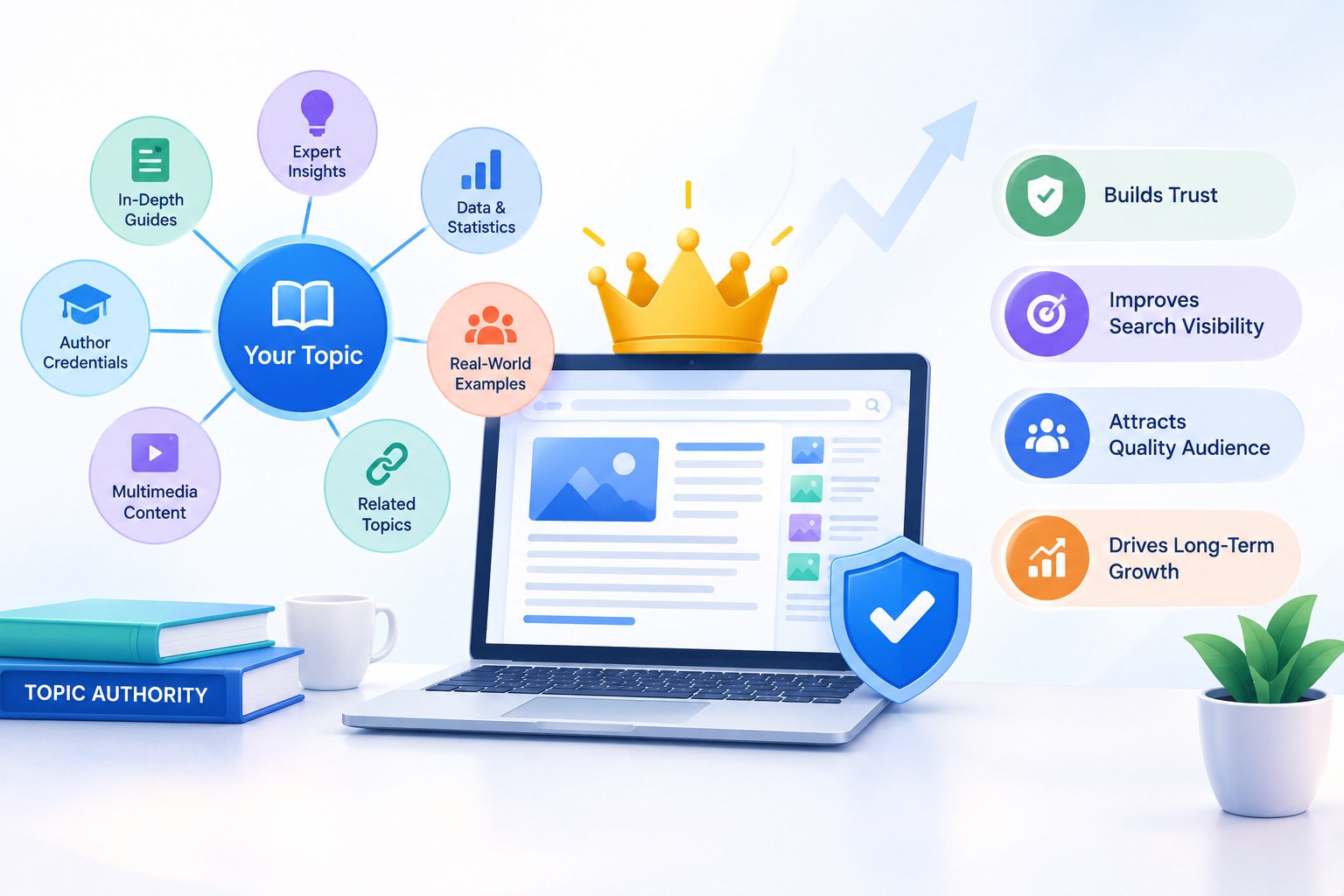
Building topical authority can help businesses establish a recognisable presence within their industry. When your website covers a subject in sufficient depth, visitors can explore related resources, learn about your expertise, and develop greater confidence in your business.
One benefit is improved topical relevance. Closely related pages can address different aspects of the same subject, helping search engines interpret your website’s overall content structure.
Another advantage is the opportunity to rank for a wider range of relevant search queries. A comprehensive resource supported by specific articles can attract visitors at different stages of their research journey.
Topical authority can also support your content marketing efforts. Rather than publishing isolated blog posts, you develop a connected library of resources that can continue attracting relevant visitors over time.
Although topical authority does not guarantee higher organic search rankings, a well-planned approach can strengthen your website’s relevance, usefulness, and overall SEO performance.
1. Choose a Clear Industry Focus and Research Your Audience
The first step in learning how to build topical authority in SEO is deciding which subjects are most relevant to your business and audience.
Start by identifying your main services, products, customer challenges, and areas of expertise. A website design company, for example, might focus on website performance, WordPress development, conversion optimisation, technical SEO, and website maintenance.
Next, conduct keyword research to discover what your audience searches for. Look beyond high-volume terms and identify specific questions, comparison searches, beginner topics, and common problems.
Analyse search suggestions, competitor content, relevant industry discussions, and keyword research tools to uncover useful opportunities. Prioritise topics that match your services and allow you to provide meaningful answers.
This is also how to find content gaps in your industry. Compare your existing content with the questions your competitors address and identify important subjects that your website has not covered adequately.
A focused content strategy gives your website a clear direction and helps prevent unrelated articles from diluting your main areas of expertise.
2. Create Topic Clusters Around Core Subjects
Topic clusters are groups of related pages organised around a central subject. They are among the most practical ways to build topical relevance with content.
For example, a website targeting SEO services could create a central guide to SEO strategy and supporting articles covering keyword research, technical SEO audits, internal linking, content optimisation, and local SEO.
The central page provides a broad overview, while supporting articles explain individual subjects in greater detail. Together, these content clusters help users explore a topic from different angles.
If you want to understand how to create topic clusters for SEO, begin with one core subject and list the related questions your audience is likely to ask. Group overlapping ideas together, then assign each distinct search intent to the most appropriate page.
Avoid creating separate articles for nearly identical keywords when they would serve the same purpose. Combining overlapping content can produce a more useful resource and reduce unnecessary duplication.
This structure also explains how to organise website content into topic clusters that are easy for visitors and search engines to navigate.
3. Develop Pillar Pages and Supporting Content
A pillar page is a comprehensive resource covering the main aspects of a broad topic. Supporting articles explore specific subtopics and link back to the relevant pillar page.
For example, a pillar page about semantic SEO could introduce search intent, entity relationships, content structure, related concepts, and content optimisation. Supporting articles could then explain each subject with practical examples.
To understand how to develop a pillar page and supporting content, start with the questions your audience needs answered. Build the main guide around the overall topic, then create focused articles that provide additional detail where necessary.
Each page should offer unique value instead of repeating information found elsewhere on your website.
This approach helps turn individual blog posts into a connected knowledge resource. It also provides a practical foundation for content planning strategies to build topical authority over time.
4. Use Semantic SEO to Cover Topics Comprehensively
Semantic SEO involves creating content that reflects the meaning, context, and relationships behind a search query rather than focusing exclusively on exact-match keywords.
For example, an article about website speed optimisation may naturally discuss Core Web Vitals, image compression, caching, page loading times, and mobile performance.
These related concepts help explain the subject thoroughly and address the practical needs of readers.
Understanding how to use semantic SEO to establish topical authority starts with researching search intent and identifying the concepts users need to understand a topic.
Include relevant terminology, examples, supporting evidence, and related questions where they improve the article. Do not add unrelated keywords merely to increase keyword coverage.
Good semantic SEO makes content easier to understand and more useful to readers while helping search engines interpret its subject matter.
5. Strengthen Internal Linking Across Related Pages
Internal linking connects relevant pages within your website. It helps users discover additional information and gives search engines clearer pathways for finding and understanding your content.
When learning how to use internal linking to build topical authority, focus on meaningful relationships between pages.
For example, a blog post about keyword research could link to your guides on search intent, topic clusters, and content optimisation. Each link should help readers explore a related concept or complete their research.
Use descriptive anchor text that accurately explains the destination page. Link from supporting articles to relevant pillar pages and connect related resources where appropriate.
Avoid adding excessive links simply for SEO purposes. Every link should have a clear purpose and improve navigation.
A thoughtful internal linking structure supports content discovery, reinforces relationships between related resources, and creates a better user experience.
6. Demonstrate Expertise and Build Website Credibility
Publishing comprehensive information is important, but becoming a trusted source requires more than covering keywords.
Google’s E-E-A-T framework refers to experience, expertise, authoritativeness, and trustworthiness. Although E-E-A-T is not itself a single ranking factor, its principles help website owners understand the qualities associated with reliable content.
To strengthen credibility, provide accurate information, use trustworthy sources, explain recommendations clearly, and include practical examples from genuine experience where available.
Keep important articles updated when information changes. Make your business details easy to find and provide clear author information when appropriate.
These practices support E-E-A-T SEO principles and help explain how to build subject matter expertise through content.
Businesses asking how to become a trusted source in their industry should prioritise transparency, consistency, and genuine expertise instead of making unsupported claims about their authority.
7. Measure Performance and Improve Your Content Strategy
Topical authority develops over time, so regularly reviewing your content is essential.
Use Google Search Console to monitor impressions, clicks, search queries, average positions, and the pages attracting organic traffic. Analytics tools can help you understand engagement and whether visitors continue exploring related resources.
To understand how to measure topical authority and SEO performance, review your website’s performance across a group of related topics rather than judging success through one keyword alone.
Look for unanswered questions, pages with declining traffic, outdated information, weak internal links, and opportunities to improve existing resources.
A content audit can reveal where articles should be updated, combined, expanded, or redirected. Prioritise improvements based on user needs and business relevance.
These insights help you improve topical authority for a website while ensuring your content remains accurate and useful as your industry evolves.
Topical Authority vs Domain Authority in SEO
Topical authority and domain authority describe different concepts.
Topical authority relates to how comprehensively and relevantly a website covers a particular subject. Domain Authority, often referring to a third-party SEO metric, estimates a website’s ranking potential using proprietary calculations.
Domain Authority is not a Google ranking score, and neither metric should be treated as a guarantee of search performance.
A website with a smaller overall backlink profile can still publish highly useful content for a specific niche. Therefore, businesses should prioritise relevant expertise, high-quality resources, and sound SEO fundamentals rather than chasing a single authority score.
Build Lasting Industry Trust Through Topical Authority
Developing topical authority requires a consistent commitment to useful content, clear website structure, and a genuine understanding of your audience. By choosing relevant subjects, creating topic clusters, strengthening internal links, and maintaining accurate resources, your business can build a stronger foundation for organic search growth.
The best ways to establish authority in your niche begin with answering real customer questions better and more comprehensively. Focus on quality instead of publishing volume, measure results regularly, and improve your resources as user needs change.
At SEOBuckinghamshire, a strategic approach to SEO helps businesses create connected content that supports discoverability, credibility, and long-term growth. If your website needs a clearer content strategy or stronger organic visibility, get in touch with SEOBuckinghamshire to explore how a focused SEO strategy can support your business goals.
If you’re looking for expert SEO services to help manage content audits, updates, and optimization strategies, reach out to SEO Buckinghamshire—a leading digital agency in the UK with over 10 years of experience in SEO, web design, and digital marketing.