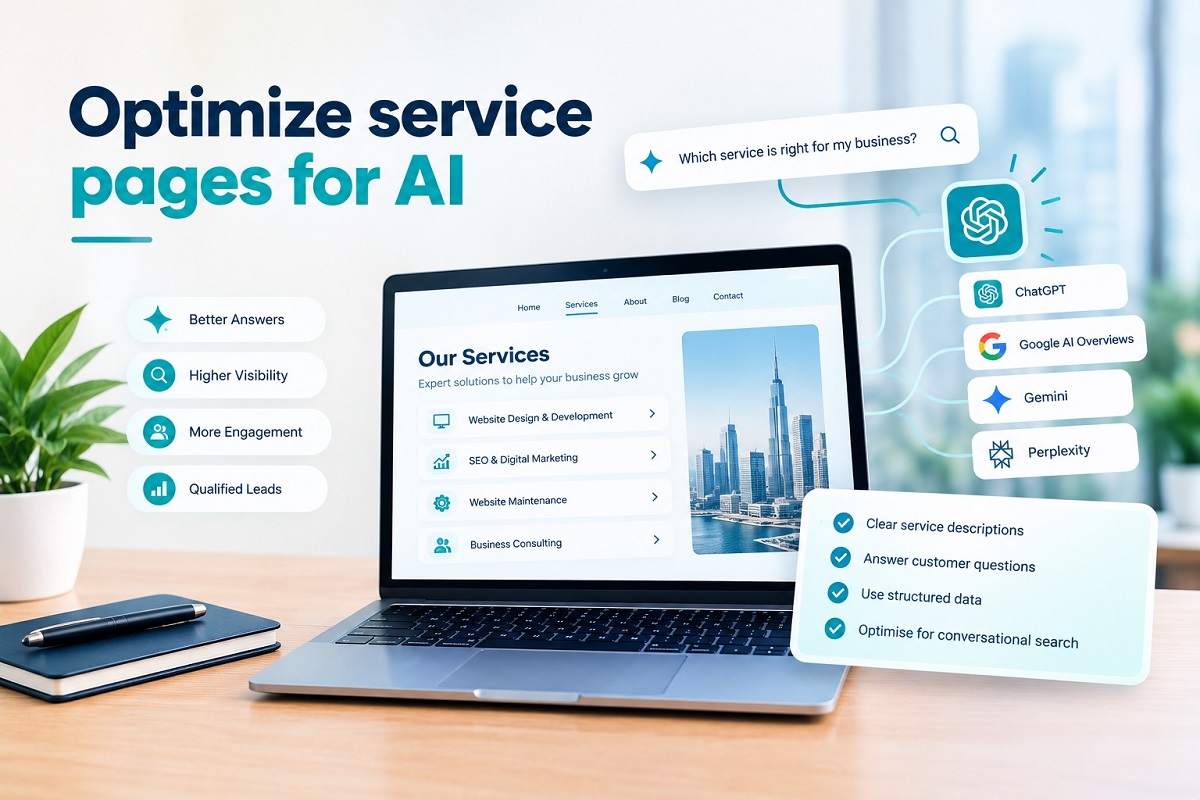
Search engines are changing how people discover businesses and compare services. Alongside traditional Google searches, users increasingly rely on AI-powered tools to research providers, understand solutions and get direct answers to their questions. For businesses, this creates a new opportunity to improve online visibility by making service pages more helpful, informative and easier for search systems to understand.
Effective AI search optimisation is not simply about adding keywords to a website. It involves understanding customer needs, providing clear answers, demonstrating expertise and organising information logically. A well-optimised service page can support traditional search engine optimisation while helping AI systems interpret your services and identify relevant information for potential customers.
Whether you offer web design, SEO, digital marketing or professional consulting, improving your service pages for AI search and customer questions can strengthen your online presence and help attract more qualified enquiries.
1. Understand Customer Questions and Search Intent
Every effective service page starts with understanding what potential customers want to know. Before contacting a business, people often ask questions about pricing, service features, expected results, delivery times and the problems a service can solve.
For example, someone searching for an SEO agency may want to know how SEO works, how long results take and which activities are included in a campaign. Your service page should address these concerns rather than focusing exclusively on promoting your business.
This is where search intent optimisation becomes important. Instead of targeting keywords without context, identify whether users are researching a problem, comparing solutions or preparing to make a purchase.
You can discover relevant questions by reviewing customer enquiries, sales conversations, search suggestions, website search data and discussions in your industry. These insights help you create service page content that reflects genuine customer needs.
Understanding intent also supports Service page SEO, because useful information can make your page more relevant to the searches you want to attract. The goal is to answer the questions that matter to your audience while explaining why your service is an appropriate solution.
2. Write Clear Answers That AI Search Systems Can Understand
AI-powered search tools often summarise information from multiple sources to answer a user’s question. Clear, direct explanations make it easier for readers and search systems to identify the main purpose of your service page.
Start each important section with a straightforward explanation before adding supporting details. If your page describes technical SEO services, explain what technical SEO involves, which website issues it addresses and how those improvements support search performance.
Avoid vague statements such as “We provide innovative solutions for business growth” without explaining what you actually do. Replace generic claims with specific descriptions of your services, processes and deliverables.
This approach supports Answer Engine Optimisation, also known as AEO, by presenting useful information in a format that can respond to common questions. It also strengthens AI SEO, which focuses on making content relevant and understandable across AI-influenced search experiences.
However, clear content alone does not guarantee that an AI platform will cite or recommend your business. Search visibility also depends on factors such as relevance, source availability, technical accessibility and the quality of competing information.
3. Use Question-Based Content Naturally
One practical way to improve service page optimisation is to incorporate the questions customers genuinely ask. These questions can become headings, short explanatory sections or frequently asked questions near the bottom of a page.
For a website design service, useful questions might include:
- How much does professional website design cost?
- How long does it take to build a business website?
- Is a mobile-friendly website important for SEO?
- Can an existing website be redesigned?
- What is included in a website maintenance service?
Answer each question accurately and provide enough context to help users make informed decisions. Avoid giving identical, generic answers across multiple service pages.
This type of question-based content supports conversational search because people often phrase queries as complete questions rather than short keyword combinations. It can also help your page address longer, more specific searches.
The key is to keep answers focused. Explain the main point first, then add details about relevant factors, limitations or next steps. If costs depend on project scope, for example, explain which factors influence pricing instead of promising a fixed amount that may not apply to every customer.
4. Apply Generative Engine Optimisation to Service Pages
Generative Engine Optimisation (GEO) involves improving how your content can be understood, discovered and potentially referenced by generative AI search experiences. For service businesses, this means making important information accessible, specific and supported by credible evidence.
Begin by describing each service precisely. Explain who it is for, which problems it solves, what the process involves and what customers can reasonably expect. Include meaningful details about your experience, methods, relevant qualifications and examples of completed work where available.
For example, an SEO service page could explain its approach to technical audits, content optimisation, internal linking, keyword research and performance measurement. This gives readers a clearer understanding of the work involved than a page containing only broad marketing statements.
Effective GEO SEO also benefits from consistent information across your website. Your service descriptions, company details, case studies and supporting articles should communicate a coherent picture of your expertise.
Do not make unsupported claims about being the best provider or guaranteeing first-page rankings. Trustworthy information is more valuable than exaggerated promises, particularly when users are comparing businesses before making a decision.
5. Improve Website Structure and Semantic SEO
A well-organised page helps visitors find answers quickly and gives search systems clearer signals about how information relates to a particular service.
Use one clear main heading, followed by descriptive subheadings that organise the page into logical sections. Depending on the service, these might cover benefits, features, the working process, pricing considerations, common questions and next steps.
This supports semantic SEO, which focuses on meaning, context and relationships between concepts rather than relying solely on exact keyword matches.
For example, a local SEO service page may naturally discuss Google Business Profile optimisation, local search visibility, business listings, location-based searches and customer reviews. These related concepts help explain the service comprehensively without repeatedly inserting the same phrase.
Good website content optimisation also includes readable paragraphs, descriptive links, useful images with appropriate alternative text and a mobile-friendly layout. Important service details should appear in accessible page content rather than being hidden entirely inside images or interactive elements that may be difficult to access.
Use structured data where appropriate, ensuring it accurately reflects information visible on the page. Structured data can help search engines interpret your content, but it does not guarantee enhanced search appearances or inclusion in AI-generated responses.
6. Optimise for Conversational and Voice Search
People using voice assistants and AI chat tools often ask natural questions, such as “Which SEO service is right for a small business?” or “How can I improve my website’s Google rankings?”
To support conversational search, write in a natural style and use the terminology your customers understand. Explain technical concepts in plain English and provide enough detail to answer follow-up questions.
Voice search optimisation follows many of the same principles. Clear headings, concise answers and accurate local business information can help make your content useful for spoken queries.
If you serve a specific location, explain the areas you cover and the services available there. However, avoid creating multiple nearly identical location pages with only the city name changed. Each page should offer useful, location-specific information.
Remember that voice search and AI search are not identical. You do not need to write every sentence as if someone were speaking aloud. Instead, focus on natural language, clear answers and a page structure that supports different ways of searching.
7. Strengthen Technical Accessibility and Trust
Even excellent content may struggle to reach users if search systems cannot access or interpret it properly. Technical checks should therefore form part of your AI search optimisation strategy.
Make sure important service pages return the correct status codes, can be crawled where intended and are not accidentally blocked by robots.txt rules or noindex directives. Review canonical tags, internal links, page speed and mobile usability.
For relevant AI search platforms, check their published crawler documentation and access requirements. For example, websites seeking visibility in ChatGPT search should review OpenAI’s guidance on allowing OAI-SearchBot. Crawler access supports eligibility for discovery but does not guarantee placement.
Trust is equally important. Include genuine testimonials, relevant case studies, transparent service details and accurate business information where appropriate. Explain what your process includes and avoid presenting estimates or potential outcomes as guaranteed results.
These practices support broader search engine optimisation while giving prospective customers stronger reasons to trust your business.
8. Measure AI Search Visibility and Improve Your Pages
Successful AI search optimisation requires ongoing evaluation. Traditional SEO metrics remain useful, including organic traffic, keyword performance, enquiries, conversions and engagement with service pages.
You should also monitor whether your business appears in relevant AI-generated answers where such checking is possible. Test realistic customer questions across different AI search platforms, record whether your business or website is mentioned, and compare the answers over time. Results may vary by platform, query and location.
Use analytics and search performance data to identify pages that attract visitors but generate few enquiries. The problem might be unclear pricing, missing service details, weak calls to action or a mismatch between the page and the visitor’s needs.
Do not focus exclusively on AI search rankings, because AI platforms may not provide a consistent, directly comparable ranking position. Instead, assess the wider picture: whether customers can find your business, understand your services and take the next step.
Regularly update outdated information, expand sections that leave important questions unanswered and remove repetitive content that adds little value.
Make Your Service Pages More Useful for People and AI Search
Optimising service pages for AI search and customer questions is an extension of good website content practice. It combines clear communication, search intent optimisation, relevant expertise, accessible page structure and a genuine understanding of what potential customers need.
By integrating Answer Engine Optimisation, Generative Engine Optimisation and traditional SEO principles, businesses can build service pages that explain their value more effectively and support visibility across evolving search experiences.
Start by reviewing one important service page. Identify the questions customers ask most frequently, answer them clearly, improve the page structure and ensure the technical foundations are sound. Then measure performance and continue refining the content based on real customer behaviour.
The strongest service pages are not written simply to satisfy an algorithm. They help people understand a service, compare their options and make confident decisions. That is the foundation of sustainable search visibility and better-quality enquiries.
If you’re looking for expert SEO services to help manage content audits, updates, and optimization strategies, reach out to SEO Buckinghamshire—a leading digital agency in the UK with over 10 years of experience in SEO, web design, and digital marketing.