Search is evolving beyond traditional blue links. Today, people ask questions directly through Google AI Overviews, ChatGPT, Gemini, and other AI-powered platforms to find information, compare services, and make decisions. For businesses, this creates a new opportunity to reach potential customers by providing clear, useful answers to the questions they are already asking.
This is where Answer Engine Optimisation (AEO) becomes important. Instead of focusing only on ranking web pages, AEO encourages businesses to make their content easy to understand, relevant to user questions, and useful for systems that generate direct answers.
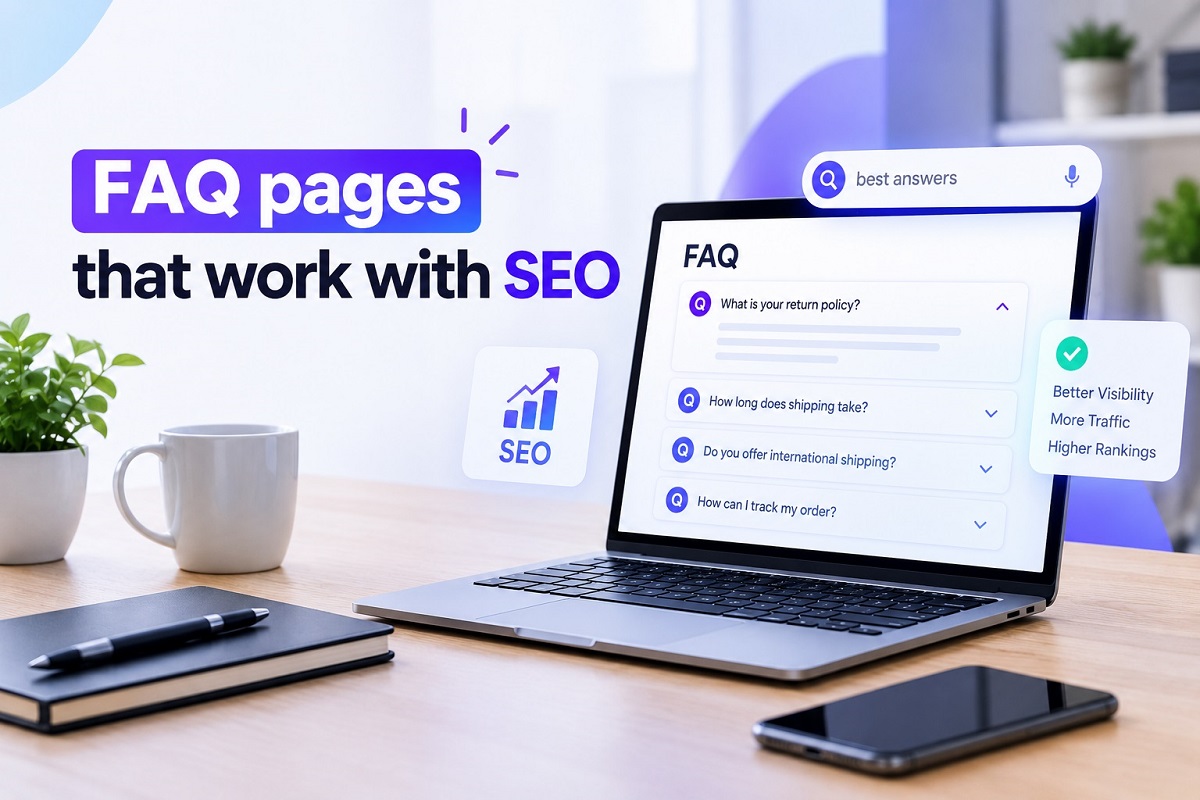
Well-written FAQ pages can support this approach by addressing customer concerns, explaining services, and providing straightforward information. However, simply adding questions to a website is not enough. Effective FAQ page optimisation requires thoughtful keyword research, clear answers, helpful content, and sound technical SEO.
In this guide, we explain how to write FAQ pages that work with AEO and support your wider AI search optimisation strategy.
What Is Answer Engine Optimisation (AEO)?
Answer Engine Optimisation is the process of structuring and improving content so that it can better address questions asked through search engines, voice assistants, and AI-powered answer platforms.
Traditional SEO focuses on helping web pages appear in relevant search results. AEO builds on those foundations by emphasising direct answers, natural-language questions, clear explanations, and well-organised information.
For example, instead of targeting only the keyword “website maintenance,” a business could answer a specific question such as “How often should a business website be maintained?” This approach matches the way people naturally search for information.
AEO SEO does not replace traditional SEO. Both rely on useful content, accessibility, relevance, and a positive user experience. The aim is to help people find accurate answers while making your website easier for search systems to interpret.
1. Research Questions Your Customers Actually Ask
The first step in creating effective AEO content is understanding what your audience wants to know.
Start by reviewing customer emails, sales conversations, support requests, website search data, and questions received through social media. These sources can reveal common concerns that your existing website may not address clearly.
You can also use keyword research tools to discover question-based searches and related long-tail keywords. Google Search Console can help identify queries that already bring visitors to your website.
For example, a digital marketing agency might create FAQ questions such as:
- How long does SEO take to produce results?
- What is included in a local SEO service?
- How much does website maintenance cost?
- Can SEO improve visibility in AI search results?
Choose questions that are relevant to your services and answer them accurately. Avoid adding unrelated questions simply to include more keywords.
Good FAQ SEO begins with understanding search intent, not forcing search terms into every sentence.
2. Write Clear, Direct Answers
One of the most important principles of FAQ page optimisation is to answer each question immediately.
Visitors should not have to read several paragraphs before finding the information they need. Start with a direct response, then add context, examples, or important qualifications where necessary.
For example: Question: How long does SEO take to show results?
Answer: SEO often takes several months to produce meaningful improvements, although the timeline depends on competition, website condition, content quality, and the work involved. Some changes may produce earlier results, but sustained growth usually requires ongoing optimisation.
This answer addresses the question first and explains the factors that influence the outcome.
Clear, self-contained answers can help users understand your content and make it easier for search systems to interpret. They may also support featured snippets and AI-generated answers when the content is relevant and selected by the platform.
There is no ideal answer length for every question. Keep simple answers concise and provide more detail when the subject requires it.
3. Use Natural Language and Conversational Search Queries
People often phrase questions differently when speaking to an AI assistant than when typing a short keyword into Google. Conversational search reflects this behaviour, using complete questions and natural language.
Your FAQ headings should reflect the way your customers communicate. For example, “What does ecommerce SEO cost?” may be more useful than a heading containing only “ecommerce SEO pricing.”
Use the language your audience understands, including relevant industry terms where appropriate. Avoid awkward phrasing created by inserting exact-match keywords into every heading.
This approach supports AI search optimisation because it connects your content with specific questions and their underlying intent.
However, you do not need a separate FAQ for every variation of the same query. Group closely related questions where a single, comprehensive answer can satisfy the user’s needs.
4. Structure Your FAQ Content for People and Search Engines
A well-organised page makes information easier to scan, navigate, and understand.
Use a clear H1 heading for the page topic, followed by relevant H2 headings to group related questions. Format each question consistently and place its answer directly underneath.
For longer FAQ pages, consider grouping questions into categories such as pricing, services, technical support, delivery, or refunds. Add internal links to detailed service pages or guides when readers need more information.
This structure supports AI SEO by making the relationship between questions and answers clear. It also improves usability for visitors who want to find specific information quickly.
Avoid hiding important answers exclusively inside scripts or interactive elements that may not be accessible to search crawlers. Test the page on mobile devices and make sure the content remains readable and accessible.
5. Understand FAQ Schema and Structured Data SEO
FAQ schema is structured data that describes frequently asked questions and their answers in a format supported by search technologies. It can help clarify the meaning and organisation of page content for systems that process the markup.
However, it is important to understand its current limitations. Google restricted FAQ rich results largely to authoritative government and health websites in 2023, and FAQ rich results are no longer displayed in Google Search as of May 2026. Adding FAQPage markup should therefore not be presented as a way to win expandable FAQ listings on Google.
You can review Google’s guidance on structured data policies to understand the requirements for accurate markup.
Structured data SEO remains useful for supported search features, but the markup must accurately represent visible page content. It does not guarantee higher rankings, AI citations, or enhanced search appearances.
For most business websites, prioritise useful answers, accessible content, and correct technical implementation rather than treating schema as a shortcut to visibility.
6. Make Your FAQ Pages Useful for Generative Engine Optimisation
Generative Engine Optimisation focuses on improving how brands and their content may be discovered, understood, and represented in AI-generated responses.
FAQ pages can contribute by explaining your expertise, services, policies, and solutions in straightforward language. They can also address questions that potential customers ask before choosing a provider.
For example, a web design company could explain its website development process, typical project timelines, maintenance options, and support arrangements. These answers help prospective customers evaluate the service while giving search systems clearer information about the business.
To strengthen your approach, keep facts consistent across your website and other trusted sources. Support claims with evidence where appropriate, update outdated answers, and link to relevant detailed resources.
You should also check whether search crawlers can access your important pages. For ChatGPT search, OpenAI recommends allowing its OAI-SearchBot to crawl website content intended to be eligible for discovery and inclusion in search results. See the official ChatGPT search guidance.
These steps can improve eligibility for discovery, but they cannot guarantee that an AI platform will select or cite your content.
7. Measure Performance and Keep Answers Updated
Publishing an FAQ page is only the beginning. Review its performance to understand whether it helps users and supports your broader search strategy.
Use Google Search Console to monitor relevant queries, impressions, clicks, and page performance. Review engagement and enquiries through your analytics platform, and identify questions that visitors continue to ask after reading your content.
Where referral tracking is available, examine visits arriving from AI platforms. You can also test representative questions in different AI tools to understand whether your business appears and which sources are referenced. Treat these checks as directional indicators because responses can change between queries and platforms.
Update answers when prices, policies, products, services, or technical requirements change. Remove redundant questions and expand explanations where customers still need clarification.
A useful FAQ page should evolve alongside your business and your audience’s needs.
Build FAQ Pages That Deliver Real Value
Effective FAQ pages do more than target keywords. They help customers solve problems, understand services, and make informed decisions.
By researching genuine questions, writing direct answers, using natural language, organising information clearly, and maintaining accurate content, you can build a stronger foundation for Answer Engine Optimisation.
Combine these practices with traditional SEO, relevant internal links, accessible technical foundations, and a thoughtful Generative Engine Optimisation strategy. This creates content that serves real users while improving your website’s readiness for changing search experiences.
There is no guaranteed formula for appearing in featured snippets or AI-generated answers. The most sustainable approach is to publish accurate, helpful information that deserves to be found, understood, and trusted.
If you’re looking for expert SEO services to help manage content audits, updates, and optimization strategies, reach out to SEO Buckinghamshire—a leading digital agency in the UK with over 10 years of experience in SEO, web design, and digital marketing.