Search engines are becoming more sophisticated in how they interpret website content, identify entities, and connect information. With the growth of AI search, businesses are exploring new ways to make their websites easier to understand and discover. One technique that deserves attention is schema markup.
But does schema markup help AI search engines understand your website? The answer requires some context. Structured data can provide explicit information about a page’s content, organisation, products, and other entities. However, it does not guarantee that your website will appear in AI-generated answers or achieve higher search rankings.
In this guide, we explain how schema markup works, its relationship with AI SEO, and how businesses can use it as part of a practical search optimisation strategy.
What Is Schema Markup?
Schema markup is a type of structured data that helps search engines interpret information published on a website. It uses a standard vocabulary from Schema.org to describe entities such as articles, organisations, products, services, events, and frequently asked questions.
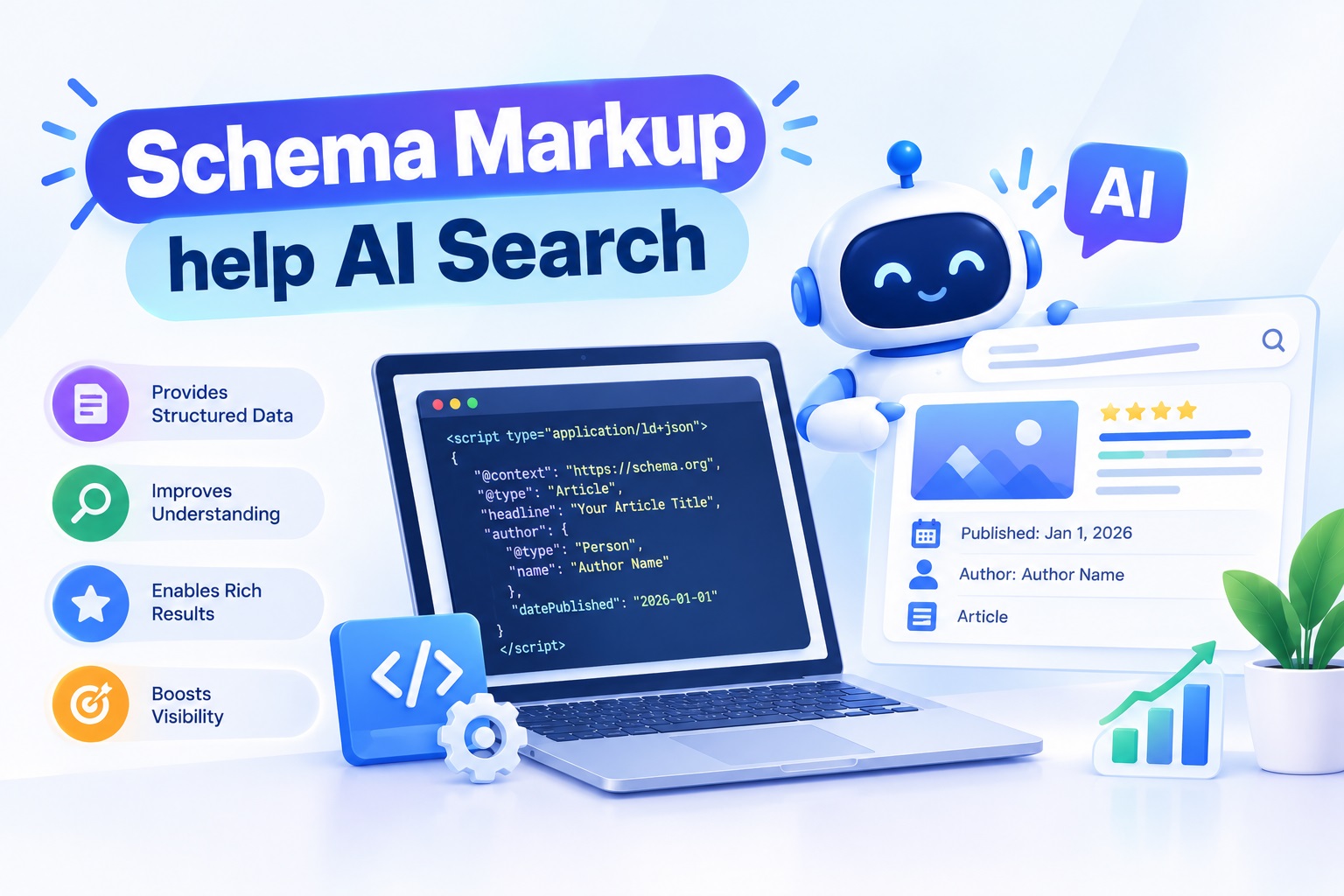
For example, a blog post might contain a title, author, publication date, and featured image. While search engines can often identify these elements from the page itself, structured data can explicitly label their meaning and relationships.
This additional context can reduce ambiguity and help search engines process information more accurately.
Website schema can be implemented using formats such as JSON-LD, Microdata, or RDFa. JSON-LD is generally a convenient choice because it allows structured data to be added separately from the visible page content.
For businesses investing in technical SEO, schema markup is a practical way to describe website information in a consistent, machine-readable format.
Does Schema Markup Help AI Search Engines Understand Your Website?
Schema markup can help search engines interpret specific details about your website by providing explicit information about your content and the entities it describes. This may support systems that use structured information when processing web pages.
However, it is important to distinguish between helping a search engine understand information and influencing whether an AI system selects that information for an answer.
AI search engines use multiple signals and processes to discover, retrieve, interpret, and evaluate information. These can include page content, relevance, authority, accessibility, and other contextual signals. Structured data is only one part of the wider picture.
Google’s guidance explains that structured data can help its systems understand page content and make pages eligible for supported search enhancements. Nevertheless, websites do not need special schema markup to appear in Google AI Overviews or AI Mode.
Therefore, schema markup should support a broader content and search strategy rather than serve as a shortcut to AI visibility.
How Structured Data Supports AI SEO?
Structured data can provide useful context about what a page represents. This is particularly valuable when a website contains multiple related entities, such as a business, its services, its authors, and its published articles.
Consider a digital marketing agency with separate pages for SEO, website design, and content marketing. Appropriate structured data can describe the organisation and clarify the purpose of individual pages.
When this information is consistent with the visible content, it may help search engines interpret the relationships between those entities.
Schema SEO is most effective when it complements helpful content, clear navigation, and a technically accessible website. It should not be treated as a replacement for these fundamentals.
Businesses working on AI search optimisation should also focus on making important information easy to find, keeping service descriptions accurate, and publishing original material that answers genuine customer questions.
Which Schema Types Should Your Website Use?
The right schema types depend on your website, its content, and the features supported by search engines. Adding every available schema type is unnecessary and may create misleading or irrelevant markup.
Here are several useful options to consider.
- Organization schema: Describes a business, including relevant details such as its name, website, logo, and official contact information. Accurate information can help search engines identify the organisation associated with a website.
- Article schema: Provides details about editorial content, including its headline, author, publication date, and modification date. It is suitable for many blog posts and news articles.
- BreadcrumbList schema: Describes a page’s position within a website hierarchy, helping communicate relationships between sections and pages.
- Product schema: Describes eligible product information, such as a product name, image, price, and availability, where relevant and supported.
- LocalBusiness schema: Provides details about a local business, such as its address, opening hours, and contact information, when applicable.
Choose schema based on the actual content of each page. Accurate implementation is more valuable than adding unnecessary markup in an attempt to influence AI-generated answers.
Why JSON-LD Is a Practical Choice?
JSON-LD is a structured data format widely used for schema implementation. It represents information in a machine-readable structure that can be added to a page without inserting markup throughout every visible HTML element.
For example, an Article schema can describe a blog post’s headline, author, publication date, and publisher. An Organization schema can describe a company’s identity and official website.
When implementing JSON-LD, ensure the information matches the content users can see on the page. Do not add fabricated reviews, misleading prices, hidden information, or unsupported claims.
Also check for duplicate or conflicting schema generated by your content management system and plugins. WordPress websites, for instance, may already output structured data through an SEO plugin or theme.
Good website optimisation involves keeping this markup accurate, relevant, and technically valid rather than simply increasing the amount of structured data on a page.
Schema Markup, GEO, and AEO: What Is the Connection?
Generative Engine Optimisation (GEO) focuses on improving the discoverability and potential citation of useful content in generative AI experiences. Answer Engine Optimisation (AEO) focuses on providing clear, relevant answers to user questions.
Schema markup can complement both approaches by describing content and entities in a consistent format. However, neither GEO nor AEO guarantees that a particular page will be selected by an AI system.
For GEO, prioritise original insights, trustworthy information, clear explanations, and strong topical coverage. For AEO, organise content around real questions and answer them directly before providing supporting details.
Semantic SEO also plays an important role. Instead of repeating the same keyword, explain related concepts and their relationships naturally. A page about technical SEO, for example, can discuss crawlability, indexing, structured data, and content accessibility where relevant.
Entity SEO complements this approach by helping businesses maintain accurate, consistent information about their organisation, services, products, and other relevant entities.
Together, these practices create a more complete approach to search engine optimisation than schema implementation alone.
How to Test and Validate Your Schema Markup?
After implementing website schema, validate it to identify errors and confirm that the markup reflects the actual page content.
Use Google’s Rich Results Test to check eligibility for supported rich results. Google’s Schema Markup Validator can help validate Schema.org structured data more generally.
Next, review relevant pages in Google Search Console to identify structured data issues where reports are available. Also check whether important pages can be crawled and indexed.
Remember that valid markup does not guarantee rich results, improved rankings, or inclusion in AI-generated answers. Search engines decide which features to display and which sources to use.
Regularly review structured data after website redesigns, plugin updates, changes to page templates, or modifications to business information.
Common Schema Markup Mistakes to Avoid
Several mistakes can reduce the usefulness or reliability of structured data.
Adding schema that does not match the visible page content can misrepresent what a page contains. Using incorrect properties, inventing reviews, or marking up information that users cannot access may also violate search engine guidelines.
Another common mistake is assuming that schema alone will improve AI search visibility. Even technically valid structured data cannot compensate for thin content, poor website accessibility, or irrelevant information.
Avoid duplicating schema unnecessarily, and do not add FAQ or other markup solely because you expect a special search feature. Eligibility and display depend on the relevant search engine’s requirements.
The best approach is to use only appropriate schema types, validate them regularly, and prioritise the overall quality of the website.
Build a Stronger AI Search Strategy With Schema Markup
Schema markup can help search engines interpret structured information about your website, but it is not a guaranteed ranking factor or a direct route to AI citations.
For sustainable results, combine accurate JSON-LD, relevant structured data, strong technical SEO, helpful content, and consistent entity information. Support these efforts with a thoughtful GEO and AEO strategy that addresses real user questions.
At SEOBuckinghamshire, we recommend treating schema markup as one component of a comprehensive AI search optimisation plan. When your website is technically accessible, your content is genuinely useful, and your structured data accurately describes what users see, you create a stronger foundation for long-term search visibility.
If you’re looking for expert SEO services to help manage content audits, updates, and optimization strategies, reach out to SEO Buckinghamshire—a leading digital agency in the UK with over 10 years of experience in SEO, web design, and digital marketing.